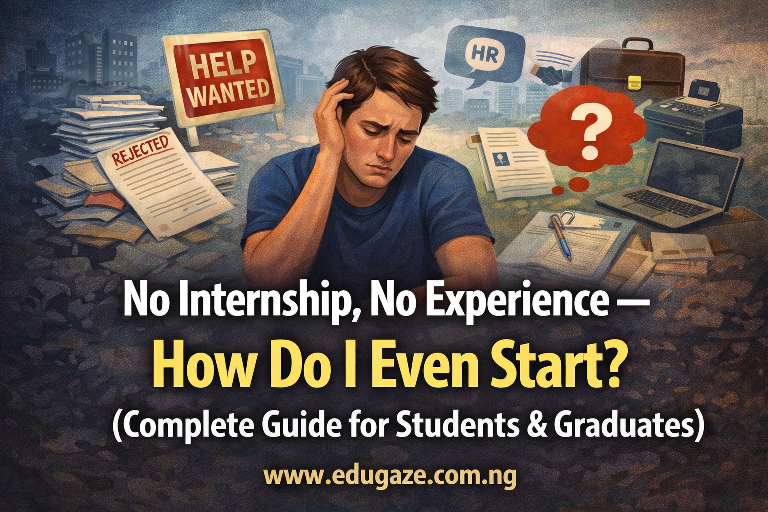
No Internship & Experience — How Do I Even Start?
I will like us to be honest that this stage of life can feel confusing, frustrating, and even a little unfair.
You’ve either graduated or you’re close to it. Everywhere you turn, you keep hearing the same advice:
“Get experience.”
But here’s the problem no one seems to address:
How do you get experience when every opportunity requires experience?
It feels like a dead end.
Like you’re locked out before you even begin.
And if you’ve been thinking things like:
- “Maybe I’m already behind”
- “Others seem to have it figured out”
- “Did I miss something important along the way?”
You’re not alone.
More importantly, you’re not stuck.
You’re just at the part of the journey that most people struggle to navigate — and very few explain properly.
This guide is here to change that.
The Honest Truth I Want You To Know Is;
There’s a misconception that keeps many beginners stuck.
It goes like this:
“You need experience before anyone will take you seriously.”
That’s not entirely true.
What people actually care about is much simpler:
Can you do the work?
That’s it.
Not where you learned it.
Not whether you had an internship.
Not how many years of experience you have.
They want proof that you can deliver.
And here’s the good news:
Proof doesn’t only come from jobs or internships.
It can come from:
- Personal projects
- Practice work
- Volunteer efforts
- Self-initiated tasks
Once you understand this, everything changes.
Instead of asking:
“How do I get experience?”
Start asking:
“How do I show what I can do?”
The major steps I’ll advice you to take now are :
Step 1: Focus on a Skill, Not a Job Title
One of the biggest mistakes beginners make is thinking too broadly.
They say things like:
- “I want to work in tech”
- “I want to go into marketing”
- “I want to be in media”
These are industries, not skills.
They’re too wide and too vague to act on.
To make progress, you need to narrow things down.
Pick a specific, practical skill you can learn and demonstrate.
For example:
- Writing
- Graphic design
- Video editing
- Social media management
- Web development
- Copywriting
Skills are powerful because they are:
- Learnable
- Measurable
- Demonstrable
You may not be able to prove you’re a “marketer” with zero experience, but you can absolutely prove you can:
- Design a social media post
- Write a blog article
- Edit a short video
Clarity at this stage is more important than ambition.
Step 2: Learn Just Enough to Start
Learning is important, but it can quickly become a trap if not done the right way.
You start watching tutorials.
You bookmark courses.
You keep telling yourself, “Just one more lesson.”
Before you realize it, weeks or even months have passed — and you haven’t actually done anything that feels like you’re making progress.
This is a common form of delay disguised as productivity.
The truth is:
You don’t need to know everything before you begin.
You just need to know enough to take the first step.
A better approach is:
- Learn the basics
- Apply immediately
Because real understanding doesn’t come from watching — it comes from doing.
Step 3: Build Your First Project
At some point, you have to stop preparing and start creating.
Your first project is important, not because it will be perfect, but because it will exist.
And that alone puts you ahead of many people.
Depending on your skill, your first project could look like:
- A blog post if you’re learning writing
- A logo or flyer if you’re learning design
- A simple website if you’re learning coding
- A short edited video if you’re learning editing
It doesn’t have to be impressive.
In fact, it probably won’t be.
But it gives you something extremely valuable:
Evidence.
Evidence that you’re not just learning — you’re doing.
That matters.
Step 4: Create Work When No One Gives You Work
One of the smartest strategies you can use at this stage is creating your own opportunities.
If no one is hiring you yet, don’t wait.
Instead, simulate real-world work.
Pick an existing business, brand, or creator and ask yourself:
- How can I improve what they’re doing?
- What would I do differently?
Then go ahead and create that.
For example:
- Redesign a company’s logo
- Rewrite a website’s content
- Plan social media posts for a brand
- Edit a better version of an existing video
This is often called speculative work.
Even though it’s not paid, it serves a powerful purpose:
It shows initiative.
It demonstrates skill.
It builds your portfolio.
And when someone sees your work, what matters most is quality — not whether you were paid to create it.
Step 5: Start Small and Build Momentum
You don’t need a big break.
You need a small beginning.
Look around you.
Opportunities often exist closer than you think:
- A friend who runs a small business
- A local shop that needs online presence
- A student group or organization
- Someone who needs help but can’t afford professionals yet
These are your starting points.
At this stage, your focus should not be on making a lot of money.
It should be on:
- Gaining experience
- Building confidence
- Creating proof
Even if you take on unpaid work, it should be intentional.
You’re not working for free indefinitely.
You’re building a foundation.
Once you have a few solid examples of your work, you can start charging.
Step 6: Make Yourself Visible
It’s not enough to have skills.
People need to know you have them.
Visibility is what connects your effort to opportunity.
You can start by:
- Sharing your work online
- Posting your progress
- Writing about what you’re learning
- Documenting your journey
You don’t need to be perfect or polished.
In fact, being real and relatable often works better.
When people see your consistency and growth, they begin to trust your ability.
And that’s when opportunities start to come.
Step 7: Accept That You Won’t Feel Ready
This is something many people struggle with.
They wait for the moment they feel confident, prepared, and ready.
That moment rarely comes.
Doubt is part of the process.
Uncertainty is part of the process.
Feeling unqualified is part of the process.
The difference between those who move forward and those who remain stuck is simple:
Some people act despite those feelings.
They don’t wait for confidence.
They build it through action.
What Starting From Zero Really Looks Like
It’s important to be honest about this stage.
Starting without experience is not easy.
You will likely:
- Compare yourself to others
- Feel like you’re behind
- Question your decisions
- Make mistakes
But none of these mean you’re failing.
They mean you’re learning.
Every skilled person you admire today once started exactly where you are.
The only difference is that they kept going.
A Simple Plan You Can Follow
If everything feels overwhelming, simplify it.
Here’s a straightforward approach:
- Choose one skill
- Learn the basics
- Create one project
- Share it publicly
- Repeat consistently
If you follow this process for even a few weeks, you will start to see change.
Within a couple of months, you’ll have:
- A small portfolio
- Practical knowledge
- Growing confidence
And most importantly, you will no longer be starting from zero.
Final Thoughts
It’s easy to feel stuck when you don’t have experience.
It’s easy to believe you’re behind.
But the reality is different.
You’re not stuck.
You’re at the beginning.
And beginnings are always uncertain.
What matters is not how perfect your start is.
What matters is that you start.
Take the first step.
Build something small.
Keep going.
That’s how every career begins.
About the Author