1-2 Fully Funded PhD Positions at University of Nebraska-Lincoln (UNL) 2026/2027 – Structural Engineering, Multi-Hazard Resilience & AI Risk Analysis
Category: Scholarships | PhD Funding | Study in USA Reading Time: ~8 minutes
Are you a civil or structural engineering graduate with a passion for research and a dream of earning your PhD at a top American university — fully funded? Then you need to stop scrolling right now, because this opportunity was made for you.
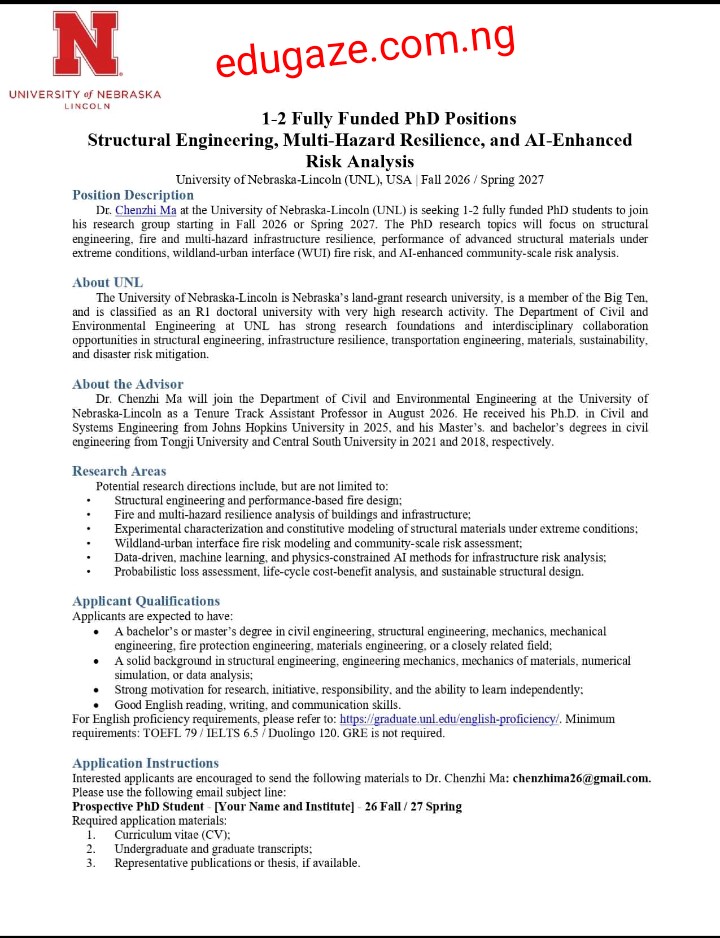
The University of Nebraska-Lincoln (UNL) is currently offering 1 to 2 fully funded PhD positions in a cutting-edge research group focused on Structural Engineering, Multi-Hazard Resilience, and AI-Enhanced Risk Analysis, with a start date of Fall 2026 or Spring 2027. These positions are open to motivated international and domestic applicants who are ready to push the frontiers of structural engineering research.
In this article, we break down everything you need to know — the research focus, the university, the advisor, the qualifications required, and exactly how to apply. Read carefully and act fast, because fully funded PhD positions like this do not stay open forever.
About the University of Nebraska-Lincoln (UNL)
Before diving into the scholarship details, it helps to understand just how prestigious this opportunity is.
The University of Nebraska-Lincoln is Nebraska’s land-grant research university and a proud member of the Big Ten — one of the most respected university athletic and academic conferences in the United States. More importantly for researchers and PhD applicants, UNL is classified as an R1 Doctoral University, the highest Carnegie classification for research activity in the United States. This means it operates at the very highest level of research output, funding, and impact.
The Department of Civil and Environmental Engineering at UNL stands out for its exceptionally strong research foundations and its culture of interdisciplinary collaboration. The department is deeply active in areas including structural engineering, infrastructure resilience, transportation engineering, materials science, sustainability, and disaster risk mitigation — all of which are globally relevant and increasingly critical fields in a world facing climate change, urbanisation pressures, and growing infrastructure demands.
In short, earning your PhD at UNL puts you in one of the most dynamic research environments in the United States.
About the Research Advisor — Dr. Chenzhi Ma
The PhD positions are in the research group of Dr. Chenzhi Ma, who will be joining UNL’s Department of Civil and Environmental Engineering as a Tenure Track Assistant Professor in August 2026.
Dr. Ma’s academic credentials are impressive. He earned his Ph.D. in Civil and Systems Engineering from Johns Hopkins University in 2025 — one of America’s most elite research universities. His master’s and bachelor’s degrees in civil engineering were obtained from Tongji University and Central South University in 2021 and 2018 respectively — both leading engineering institutions in China with strong international reputations.
This is a particularly exciting time to join Dr. Ma’s group. As a newly appointed tenure-track professor building his research team from the ground up, his PhD students will be closely mentored, highly visible within the research group, and positioned to be foundational contributors to a growing body of pioneering work. Getting in at the beginning of a research group led by a promising young professor is often one of the smartest career moves a PhD student can make.
PhD Research Areas — What Will You Be Working On?
The research topics under Dr. Ma’s group are at the intersection of traditional structural engineering and modern data science and artificial intelligence. This is exactly where the future of the field is heading, and these positions place you right at that frontier.
Potential research directions include, but are not limited to:
1. Structural Engineering and Performance-Based Fire Design Developing advanced frameworks for designing structures that maintain their performance under fire conditions — moving beyond prescriptive codes to performance-driven approaches.
2. Fire and Multi-Hazard Resilience Analysis of Buildings and Infrastructure Analysing how buildings and critical infrastructure systems respond to and recover from fires, earthquakes, floods, and other combined hazards — increasingly relevant in today’s climate environment.
3. Experimental Characterisation and Constitutive Modelling of Structural Materials Under Extreme Conditions Conducting lab-based and computational research to understand how structural materials behave under extreme loading — fire, impact, seismic activity — and developing models to predict that behaviour.
4. Wildland-Urban Interface (WUI) Fire Risk Modelling and Community-Scale Risk Assessment Studying the growing threat of wildfires spreading into residential areas — a major challenge in the USA and globally — using advanced modelling and simulation tools to assess community-level risk.
5. Data-Driven, Machine Learning, and Physics-Constrained AI Methods for Infrastructure Risk Analysis Applying artificial intelligence, machine learning, and physics-informed computational models to predict, assess, and reduce infrastructure risks — a rapidly emerging area at the intersection of engineering and data science.
6. Probabilistic Loss Assessment, Life-Cycle Cost-Benefit Analysis, and Sustainable Structural Design Developing rigorous methods for evaluating the long-term cost-effectiveness and sustainability of infrastructure systems — critical for policymakers, urban planners, and engineers alike.
These research areas are not only academically stimulating — they carry enormous real-world impact potential. From reducing wildfire casualties to building more resilient cities, this is the kind of research that genuinely matters.
What Does “Fully Funded” Mean Here?
When a PhD position at a US university is described as “fully funded,” it typically means the following are covered for the duration of your programme:
- Full tuition waiver — you pay no tuition fees
- Monthly stipend — a regular living allowance to cover your daily expenses
- Health insurance — most funded PhD positions in the US include health coverage
This is the standard package for research-based PhD positions at R1 universities in America, and Dr. Ma’s positions follow this structure. You will be supported financially throughout your studies so you can focus entirely on your research.
Who Can Apply? — Applicant Qualifications
Dr. Ma’s research group is looking for highly motivated individuals who meet the following criteria:
Academic Background Applicants should hold a bachelor’s or master’s degree in one of the following disciplines or a closely related field:
- Civil Engineering
- Structural Engineering
- Mechanics or Mechanical Engineering
- Fire Protection Engineering
- Materials Engineering
- Or any closely related engineering discipline
Technical Skills A solid background in at least one of the following areas is expected:
- Structural engineering fundamentals
- Engineering mechanics or mechanics of materials
- Numerical simulation and computational methods
- Data analysis and data-driven research methodologies
Personal Qualities Beyond academic qualifications, the advisor is specifically looking for students who demonstrate:
- Strong motivation for research
- Initiative and the ability to work independently
- A sense of responsibility and self-discipline
- Good English reading, writing, and communication skills
English Proficiency Requirements For international applicants, the minimum English language proficiency requirements are:
- TOEFL: 79
- IELTS: 6.5
- Duolingo: 120
For full details on English proficiency requirements, applicants can visit: https://graduate.unl.edu/english-proficiency/
It is also worth noting that the GRE is not required for this application — a welcome relief for many international applicants.
How to Apply — Step-by-Step Application Instructions
The application process for these PhD positions is direct and straightforward. Here is exactly what you need to do:
Step 1 — Prepare Your Application Materials Gather the following required documents:
- Curriculum Vitae (CV) — a comprehensive academic and professional resume highlighting your education, research experience, publications, projects, and skills
- Undergraduate and Graduate Transcripts — official or unofficial academic transcripts from all universities attended
- Representative Publications or Thesis (if available) — any published research papers, conference papers, or your undergraduate/master’s thesis that demonstrates your research capability
Step 2 — Send Your Application Email Email your application materials directly to Dr. Chenzhi Ma at:
- chenzhima26@gmail.com
Step 3 — Use the Correct Email Subject Line This is very important. Your email subject line must follow this exact format:
Prospective PhD Student – [Your Name and Institute] – 26 Fall / 27 Spring
Using the correct subject line ensures your email is identified and processed properly. Emails that do not follow this format may be overlooked.
Tips to Make Your Application Stand Out
Competition for fully funded PhD positions at top American universities is fierce. Here are practical tips to help your application rise above the rest:
- Craft a Tailored Cover Email, Not Just Attachments Do not simply attach your documents and send a blank email or a generic two-liner. Write a brief but compelling introductory email that explains who you are, what your academic background is, which specific research area(s) from Dr. Ma’s list excite you the most, and why you believe you are a strong fit for his group. Keep it concise — three to four well-written paragraphs.
- Highlight Relevant Research Experience If you have previously worked on any projects related to structural engineering, fire engineering, computational modelling, or AI-driven data analysis, make this the centrepiece of your CV and email. Concrete research experience is what separates competitive applicants.
- Mention Specific Research Areas Show Dr. Ma that you have studied his research interests. Mentioning one or two specific research directions from his group — and explaining how your background connects to them — demonstrates genuine interest and preparation.
- Prepare a Strong CV Your CV should be clean, professional, and clearly structured. Include your education, GPA, research experience, publications or thesis work, technical skills (software, programming languages, simulation tools), and any awards or scholarships received.
- Apply Early These positions are for Fall 2026 and Spring 2027. The earlier you reach out, the better your chances of getting a response before the available slots are filled. Do not wait.
Why This PhD Opportunity Is Worth Your Attention
Let us be direct about why this particular opportunity stands out, especially for African and international applicants:
It is fully funded at a top US university — no tuition fees, no self-funding, just your research.
The research is globally relevant — wildfire risk, infrastructure resilience, and AI-enhanced risk assessment are not American problems; they are worldwide challenges that graduates in this field will be sought after to address.
You are joining a growing research group early — as one of the first 1–2 PhD students of a newly appointed professor at a prestigious R1 university, the mentorship, co-authorship opportunities, and academic exposure will be exceptional.
The GRE is not required — this removes one of the most common barriers for international students applying to US PhD programmes.
The advisor trained at Johns Hopkins — one of the most elite universities in the world. His academic pedigree is strong, and that reflects in the quality of training you will receive.
Apply Now — Direct Contact Details
If you have read this far and you are excited about this opportunity, do not delay. Reach out to Dr. Chenzhi Ma today with your application materials.
- Email: chenzhima26@gmail.com
- Subject Line: Prospective PhD Student – [Your Name and Institute] – 26 Fall / 27 Spring
- Required Attachments: CV, Transcripts, Publications or Thesis (if available)
- Start Date: Fall 2026 or Spring 2027
- University: University of Nebraska-Lincoln (UNL), USA
For more information about the English proficiency requirements for graduate admission at UNL, visit:
Our Final Thoughts
Fully funded PhD positions at R1 American universities in high-impact research fields do not come around every day, and they certainly do not stay available for long once announced. The 1–2 Fully Funded PhD Positions at the University of Nebraska-Lincoln under Dr. Chenzhi Ma represent a genuinely outstanding opportunity for civil and structural engineering graduates who are ready to take their careers to the next level.
If you have the academic background, the drive, and the passion for research in structural engineering, hazard resilience, or AI-enhanced risk analysis, then this is your call to action. Prepare your documents, write that email, and take the shot.
Your PhD journey at one of America’s top research universities could begin right here.
Found this helpful? Share this post with your engineering colleagues, classmates, or anyone you know who could benefit from this opportunity. One share could change a career trajectory.
About the Author