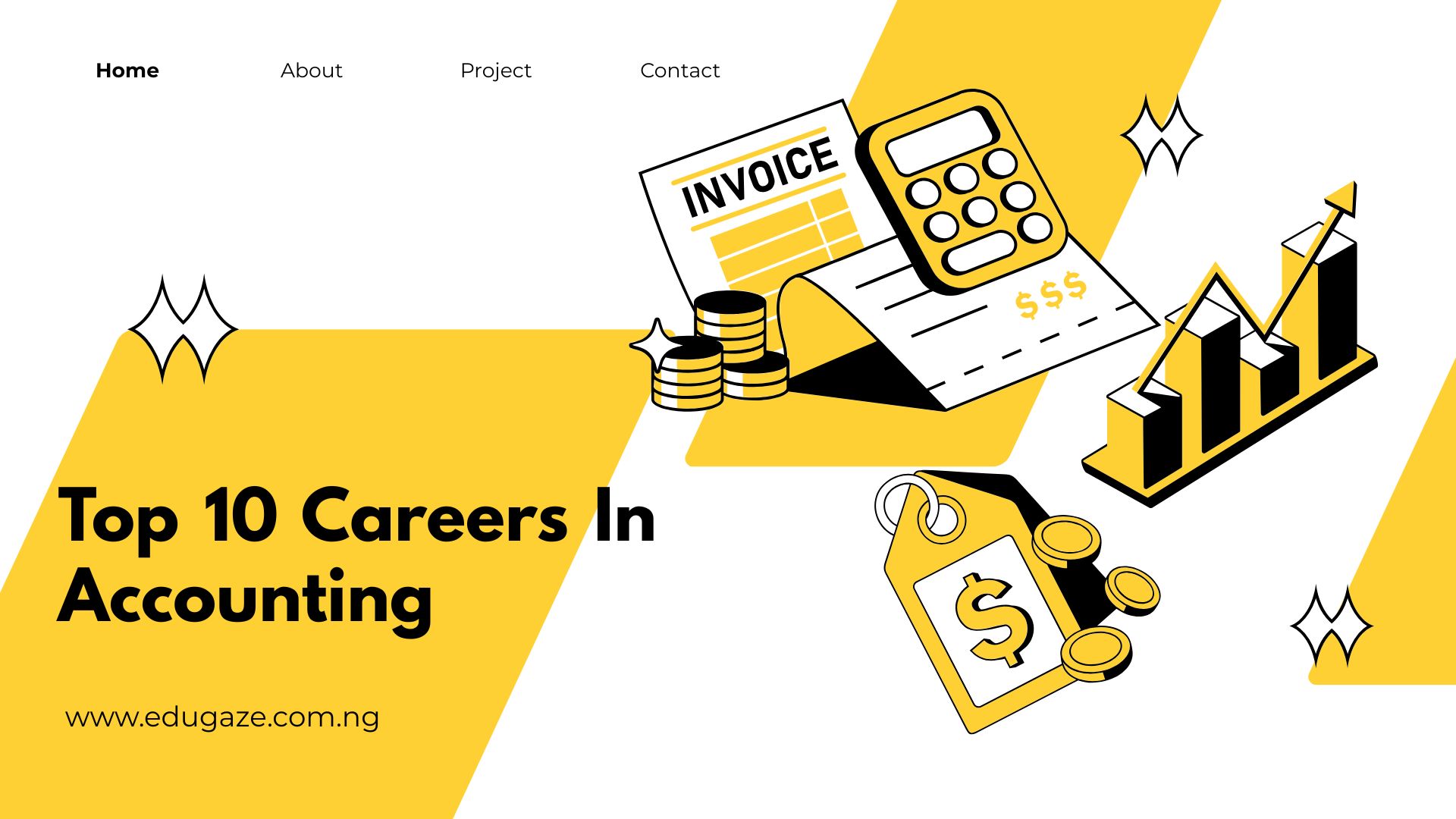
Ultimate Career Guide: Top 10 Careers in Accounting to Pursue This Year (With Salaries, Skills, and Hidden Realities)
Choosing a career path in accounting used to be simple: you pass your exams, join a local firm, balance ledgers, and slowly climb the corporate ladder toward a partnership.
However, the modern accounting landscape has shifted dramatically. Automation, artificial intelligence (AI), complex global tax compliance frameworks, and forensic regulatory oversight have transformed accounting from a back-office tracking role into an engine of strategic business intelligence.
If you are an accounting student at a top public institution like the University of Cross River State (UNICROSS), a recent graduate, or a professional aiming to pivot, understanding where the market is going is vital. The traditional paths are overcrowded, but specialized, tech-forward accounting roles are facing a massive global talent shortage.
This highly detailed, Search Engine Optimization (SEO)-optimized blueprint breaks down the top 10 careers in accounting. We look beyond generic job descriptions to explore the technical toolkits, actual daily operations, salary projections, and competitive positioning you need to outrank the competition and land your dream role.
The Evolutionary Shift: Why Traditional Accounting Is Dead
Before diving into the top roles, we must address the elephant in the room: AI and automated bookkeeping.
Many legacy blogs warn that accounting is a dying profession. They are wrong. Traditional bookkeeping is fading, but advanced financial governance is expanding. Modern companies do not need humans to manually type invoices or match receipts; software does that in milliseconds. What companies desperately need are financial architects who can read the data, predict cash flow constraints, defend against tax audits, and identify systemic risk.
To achieve high search visibility and outpace legacy job-board articles on Google, this guide categorizes careers by actual market demand, technological integration, and financial trajectory.
The Top 10 Careers in Accounting
1. Forensic Accountant & Fraud Investigator
- Primary Focus: Uncovering financial crimes, embezzlement, money laundering, and asset hidden schemes.
- Core Toolkit: SQL, EnCase Forensic, Python (for data parsing), Advanced Excel, IDEA Data Analysis.
- Average Salary Range: $78,000 – $125,000 / ₦8,000,000 – ₦18,000,000 per annum.
- Key Credentials: CFE (Certified Fraud Examiner), CPA (Certified Public Accountant), or ICAN/ANAN Forensic Faculty.
Forensic accounting sits at the intersection of accounting, legal investigations, and digital forensics. Unlike traditional auditors who look at financial statements to ensure general compliance, forensic accountants look for deliberate deception.
What the Daily Work Actually Looks Like
You will not be staring passively at balanced ledgers. Instead, you will reconstruct altered or destroyed financial records, track wire transfers through offshore shell companies, and run data analytics on thousands of corporate transactions to spot anomalies (like violations of Benford’s Law). Forensic accountants often work closely with law enforcement, regulatory bodies (like the SEC or EFCC), and corporate legal teams, frequently serving as expert witnesses in court.
Why It Outranks Other Roles
The dramatic increase in corporate cybercrime and sophisticated financial fraud has made this role highly resilient to economic downturns. When companies struggle financially, internal fraud spikes, driving up the demand for qualified investigators.
2. Environmental, Social, and Governance (ESG) Controller / Sustainability Accountant
- Primary Focus: Auditing, measuring, and reporting a corporation’s carbon footprint, sustainability metrics, and regulatory environmental compliance.
- Core Toolkit: Workiva ESG, SAP Sustainability Control Tower, Greenhouse Gas (GHG) Protocol tools.
- Average Salary Range: $92,000 – $145,000 per annum (Rapidly rising due to talent scarcity).
- Key Credentials: FSA (Fundamentals of Sustainability Accounting) Credential, CPA, ACCA Sustainability Certificate.
Sustainability accounting is one of the fastest-growing niches in the financial world. Regulatory shifts globally now require public corporations to provide audited statements of their non-financial impact alongside their financial balance sheets.
What the Daily Work Actually Looks Like
As an ESG Controller, you apply the same structural rigor used in monetary accounting to environmental data. You audit supply chains to calculate Scope 1, 2, and 3 carbon emissions, verify water usage metrics, ensure compliance with carbon taxing frameworks, and draft the sustainability reports required by institutional investors.
The Hidden Reality
Because this field is relatively new, there is no century-old playbook. You will need to build reporting models from scratch and constantly adapt to evolving global standards (such as the ISSB – International Sustainability Standards Board guidelines). It is an ideal path for analytical minds who want their work to have a direct environmental impact.
3. Financial Controller
- Primary Focus: Directing corporate accounting operations, managing internal control systems, and overseeing the preparation of financial statements.
- Core Toolkit: Enterprise Resource Planning (ERP) systems (Oracle NetSuite, SAP S/4HANA), Microsoft Power BI.
- Average Salary Range: $110,000 – $165,000 / ₦15,000,000 – ₦30,000,000 per annum.
- Key Credentials: CPA, CMA (Certified Management Accountant), ACA (ICAN).
The Financial Controller is the operational powerhouse of a corporate finance department. While the Chief Financial Officer (CFO) looks outward toward strategy, investments, and market expansion, the Controller looks inward to ensure the financial machine runs without errors.
What the Daily Work Actually Looks Like
You will manage the general ledger, oversee accounts payable and receivable, lead the month-end closing process, and enforce internal controls to prevent fraud or reporting errors. You bridge the gap between raw ledger data and high-level corporate strategy.
Career Advancement Strategy
To move from a Senior Accountant to a Financial Controller, technical accounting proficiency alone is not enough. You must master modern ERP management and demonstrate leadership skills by optimizing cash-flow cycles and cutting down data processing times.
4. International Tax Specialist / Corporate Tax Consultant
- Primary Focus: Navigating cross-border tax compliance, transfer pricing, and minimizing global corporate tax liability within legal frameworks.
- Core Toolkit: Thomson Reuters ONESOURCE, Bloomberg Tax, Vertex.
- Average Salary Range: $95,000 – $150,000 per annum.
- Key Credentials: CPA, Chartered Tax Adviser (CTA), CITN (Chartered Institute of Taxation of Nigeria).
With the rise of remote work, cross-border e-commerce, and global supply chains, even mid-sized companies now face complex international tax challenges. International Tax Specialists protect companies from double taxation while ensuring compliance with varying regional laws.
What the Daily Work Actually Looks Like
You will analyze the tax implications of corporate mergers, intellectual property movement, and foreign direct investment. A major focus is transfer pricing—ensuring that transactions between different international branches of the same company are conducted at arm’s length to satisfy regulatory bodies like the IRS or FIRS.
Why It Outranks Other Roles
Tax codes are inherently complex and change frequently. This complexity creates high job security and excellent consulting opportunities, as large enterprises are willing to pay premium rates for strategies that prevent costly tax penalties.
5. Management Consultant / Performance Advisory Specialist
- Primary Focus: Analyzing internal financial structures to help corporate clients streamline operations, cut waste, and scale profitably.
- Core Toolkit: Tableau, Microsoft Excel (Advanced VBA/Macros), Alteryx.
- Average Salary Range: $85,000 – $138,000 per annum.
- Key Credentials: CMA, CIMA (Chartered Institute of Management Accountants), MBA.
Management consultants with an accounting background offer unique value to businesses. Unlike general strategy consultants, financial advisory specialists use core accounting metrics—such as contribution margins, variance analysis, and operational cost drivers—to back up their recommendations with hard data.
What the Daily Work Actually Looks Like
You will be embedded within a client company for weeks or months at a time, analyzing their cost accounting systems. You review production workflows, identify unprofitable product lines, evaluate inventory holding costs, and present data-backed restructuring plans directly to the executive board.
Key Competitive Advantage
This career path offers variety and fast-paced professional growth. It is highly suited for individuals who enjoy solving complex business problems and prefer a dynamic consulting environment over routine monthly closing cycles.
6. Information Systems (IS) Auditor & IT Accountant
- Primary Focus: Evaluating and securing the software, databases, and digital infrastructure used to process and store financial records.
- Core Toolkit: SAP GRC, ACL Analytics, SQL, cybersecurity assessment frameworks (COBIT, ISO 27001).
- Average Salary Range: $88,000 – $130,000 per annum.
- Key Credentials: CISA (Certified Information Systems Auditor), CPA, CITP (Certified Information Technology Professional).
As financial ledgers move entirely to cloud networks and decentralized databases, financial security is no longer just about locking a paper safe. It requires deep digital oversight. IS Auditors ensure that a company’s financial software is secure, accurate, and fully compliant with digital auditing standards (like SOC 1 and SOC 2 reporting).
What the Daily Work Actually Looks Like
You review data pipelines, test system access logs to ensure proper segregation of duties, verify that automated financial calculations are bug-free, and audit cloud accounting systems against potential cyber threats and data leaks.
The Unique Value Proposition
This role effectively bridges the gap between accounting and computer science. Professionals who can understand both complex financial accounting principles and relational database security are rare, commanding high premiums in the tech, banking, and e-commerce sectors.
7. Chief Financial Officer (CFO)
- Primary Focus: Driving the overarching financial strategy, capital allocation, capital structure, and investment decisions of an enterprise.
- Core Toolkit: Advanced Financial Modeling, Enterprise Risk Management (ERM) Software, Investor Relations frameworks.
- Average Salary Range: $180,000 – $350,000+ base / ₦35,000,000 – ₦80,000,000+ per annum (plus equity/bonuses).
- Key Credentials: CPA, CFA (Chartered Financial Analyst), Executive MBA.
The Chief Financial Officer represents the pinnacle of the accounting and finance hierarchy. The CFO does not log transactions; instead, they sit next to the CEO, using financial insights to steer the long-term direction of the entire company.
       [ CHIEF FINANCIAL OFFICER (CFO) ]
                       │
       ┌───────────────┴───────────────┐
       ▼                               ▼
[ FINANCIAL CONTROLLER ]      [ TREASURY & STRATEGY ]
 - Ledger Accuracy             - Capital Structure
 - Regulatory Compliance       - Investor Relations
 - Internal Controls           - Mergers & Acquisitions
What the Daily Work Actually Looks Like
A CFO’s schedule is focused on high-stakes strategy. You pitch to institutional investors, negotiate multi-million dollar lines of credit with investment banks, structure corporate acquisitions, and decide how much capital to allocate to research and development versus stock buybacks or dividends.
How to Position Yourself for This Position
The path to becoming a CFO requires a balanced combination of technical operational accounting (typically learned as a Controller or Big Four Senior Manager) and strategic financial markets mastery (corporate finance, valuation, and macroeconomic planning).
8. Corporate Investment Banker / M&A Financial Analyst
- Primary Focus: Structuring corporate mergers, acquisitions, takeovers, and initial public offerings (IPOs) through detailed financial analysis.
- Core Toolkit: Bloomberg Terminal, CapIQ, PitchBook, Advanced DCF (Discounted Cash Flow) Modeling.
- Average Salary Range: $120,000 – $220,000 per annum (Highly dependent on performance bonuses).
- Key Credentials: CFA, CPA, or an elite Master’s in Finance degree.
While investment banking is often viewed as a distinct career path from traditional accounting, top-tier Mergers & Acquisitions (M&A) groups prioritize recruiting accounting graduates. Why? Because evaluating a target company for acquisition requires a deep, forensic understanding of its balance sheets, revenue recognition methods, and hidden liabilities.
What the Daily Work Actually Looks Like
You build detailed valuation models, conduct financial due diligence on target acquisitions, draft investment memos, and design scenarios to project how a merger will impact the purchasing company’s earnings per share (EPS).
The Trade-Off
This path offers significant financial rewards and rapid exposure to high-level corporate deals. However, it requires a major trade-off in work-life balance, as junior analysts routinely work 70 to 80 hours a week during active transactions.
9. Cost Accountant & Supply Chain Analyst
- Primary Focus: Determining and optimizing the actual cost of manufacturing products or delivering services by analyzing raw materials, labor, and overhead.
- Core Toolkit: SAP Manufacturing Modules, Oracle Cost Management, Minitab.
- Average Salary Range: $72,000 – $110,000 per annum.
- Key Credentials: CMA (Certified Management Accountant), CPA.
Cost accountants are vital to manufacturing plants, heavy industries, energy corporations, and complex logistics companies. Without precise cost accounting, a company can easily misprice its goods, selling products at a hidden net loss despite high revenue numbers.
What the Daily Work Actually Looks Like
You break down the manufacturing line to calculate the exact cost per unit. This involves calculating standard costs versus actual costs (variance analysis), analyzing factory overhead allocation, evaluating scrap and waste rates, and identifying bottlenecks in production workflows.
Innovation in the Field
Modern cost accounting incorporates Activity-Based Costing (ABC) algorithms and IoT (Internet of Things) asset tracking. This allows professionals to track cost drivers in real time across global production lines, making it an excellent path for individuals who enjoy working close to physical operations.
10. Public Auditor & Assurance Specialist
- Primary Focus: Independently examining and verifying public corporate financial records to guarantee accuracy and statutory compliance for external stakeholders.
- Core Toolkit: CaseWare, Aura (PwC), Canvas (EY), Clarity (Deloitte), Voyager (KPMG).
- Average Salary Range: $65,000 – $140,000 per annum (Scales rapidly as you move from Associate to Partner).
- Key Credentials: CPA, ICAN, ACCA.
Public accounting within the “Big Four” (PwC, EY, Deloitte, KPMG) or major mid-tier networks (BDO, Grant Thornton) remains one of the most reliable foundations for an accounting career. Assurance specialists provide investors, banks, and regulators with confidence that a company’s financial reporting is transparent and accurate.
What the Daily Work Actually Looks Like
You work in audit teams to inspect client documentation, confirm bank balances directly with financial institutions, test internal ledger controls, and verify that revenue is recognized in strict accordance with accounting standards like IFRS or US GAAP.
Career Development Advantage
Starting your career in public accounting serves as an accelerated professional training ground. Spending 2 to 4 years as an external auditor exposes you to the inner financial workings of dozens of different companies, making you highly sought after for corporate management roles later on.
Comparative Career Matrix
To help evaluate these choices side-by-side, the following matrix compares each role’s analytical complexity, tech-stack reliance, and work-life balance.
| Career Path | Analytical Complexity | Tech-Stack Reliance | Work-Life Balance | Primary Career Target |
| Forensic Accountant | Exceptionally High | High (Digital Forensics) | Balanced / Stable | Fraud units, FBI, EFCC, Specialized Consultancies |
| ESG Controller | High (Non-monetary) | Medium (Evolving Tools) | Highly Balanced | Multi-national enterprises, ESG Advisory Firms |
| Financial Controller | High (Operational) | Exceptionally High (ERP) | Moderate (Busy at Close) | Mid-to-Large Corporations |
| International Tax | Exceptionally High | Medium (Tax Software) | Variable (Tax Season Peak) | Corporate Headquarters, Elite Law & Accounting Firms |
| Management Consultant | High (Strategic) | High (Data Analytics) | Fluid / Travel-heavy | Tier-1 Consultancies, Independent Practice |
| Information Systems Auditor | High (Systemic) | Exceptionally High (IT) | Balanced / Stable | Tech Firms, Banking Sector, Risk Advisory |
| Chief Financial Officer | Elite (Macroeconomic) | Medium (High Executive Dashboard) | Demanding / High-Stakes | Fortune 500, Venture Capital, Public Enterprises |
| Investment Banker | Elite (Quantitative) | High (Financial Data Platforms) | Demanding (70+ hours/week) | Wall Street, Global Investment Banks, Boutique M&A |
| Cost Accountant | High (Granular) | High (Production Supply Chain) | Balanced / Predictable | Industrial Plants, Automotive, Energy Sectors |
| Public Auditor | High (Compliance) | High (Proprietary Audit Software) | Challenging (Jan-April Peak) | Big Four Accounting Networks, Private Equity |
Strategy for Maximizing Visibility and Landing Top Accounting Roles
1. The Strategy of Specialization
The era of the general accountant is fading. If you present yourself as someone who “can do bookkeeping, tax, and payroll,” you are competing against cheap, automated software. Instead, choose a clear specialization early on—such as an IS Auditor fluent in SQL or an ESG Accountant specializing in carbon supply chain tracking. This positions you as an expert, allowing you to charge premium consulting rates or secure higher salary packages.
2. Mastering Data Analytics
The most valuable tool for a modern accountant is no longer just a calculator—it is data visualization and processing software.
[ Raw Financial Ledgers ] ──► [ SQL / Alteryx Clean-up ] ──► [ Tableau / Power BI Visualization ] ──► [ CFO Executive Actions ]
To build a competitive edge, master data workflows. Learning how to clean disorganized accounting data using SQL or Alteryx, and then transforming it into clear corporate dashboards via Power BI or Tableau, makes you an indispensable asset to any modern finance team.
3. Professional Certifications
University degrees provide foundational knowledge, but professional credentials establish credibility in the market. Align your career objectives with the right certification:
- Corporate & Advisory Trajectories: Pursue the CPA or ICAN/ACCA early on.
- Industrial, Operations, & Strategy Focus: Prioritize the CMA or CIMA.
- Technology & Cybersecurity Integration: Target the CISA designation.
Final Takeaway: Building a Future-Proof Accounting Career
Accounting is no longer just about tracking historical costs; it is about providing forward-looking strategic value. By focusing on high-demand skills like data analytics, ESG compliance, system auditing, or forensic investigation, you position yourself at the center of modern business strategy.
Identify the career path above that matches your analytical strengths, invest in mastering its specific tech stack, and pursue the relevant certifications to build a future-proof, highly rewarding career in finance.
- Share your thoughts: Which accounting specialization aligns best with your career goals? Drop a comment below or share this guide with fellow professionals looking to advance their accounting careers!
About the Author