Shell Undergraduate Scholarship Scheme for Nigerian Students — All You Must Know to Win It
If you are a Nigerian undergraduate searching for “Shell scholarship,” there is a very good chance you are confused right now — and it is not your fault. There are actually multiple different scholarship schemes all loosely branded as “Shell scholarship” in Nigeria, and almost every blog you will find online blends them all together into one confusing mess. This has caused thousands of students to apply for the wrong scheme, miss the right deadline, or misunderstand what they are actually applying for.
This guide is going to fix that confusion completely — and then walk you through exactly how the real Shell SPDC JV Undergraduate Scholarship Scheme works, what it pays, who qualifies, and the specific strategic insights that most other blogs never tell you. By the time you finish reading, you will understand this scholarship better than 95% of the people who apply for it every year — and that understanding alone will give you a real edge.
First — Let Us Clear Up the Confusion: There Are THREE Different “Shell” Scholarships
This is the single most important section in this entire guide, and it is something almost no other blog explains clearly. When Nigerians say “Shell scholarship,” they are usually talking about one of three completely separate programmes — each with different sponsors, different amounts, different eligibility, and different application portals.
1. The Shell SPDC JV University Scholarship Scheme (the classic “Shell Scholarship”) This is operated directly by the Shell Petroleum Development Company of Nigeria Limited (SPDC), as operator of the NNPC/SPDC/TotalEnergies/NAOC Joint Venture. This is the scholarship this guide is primarily about. It has existed since around the 1960s and has supported tens of thousands of Nigerian undergraduates over the decades.
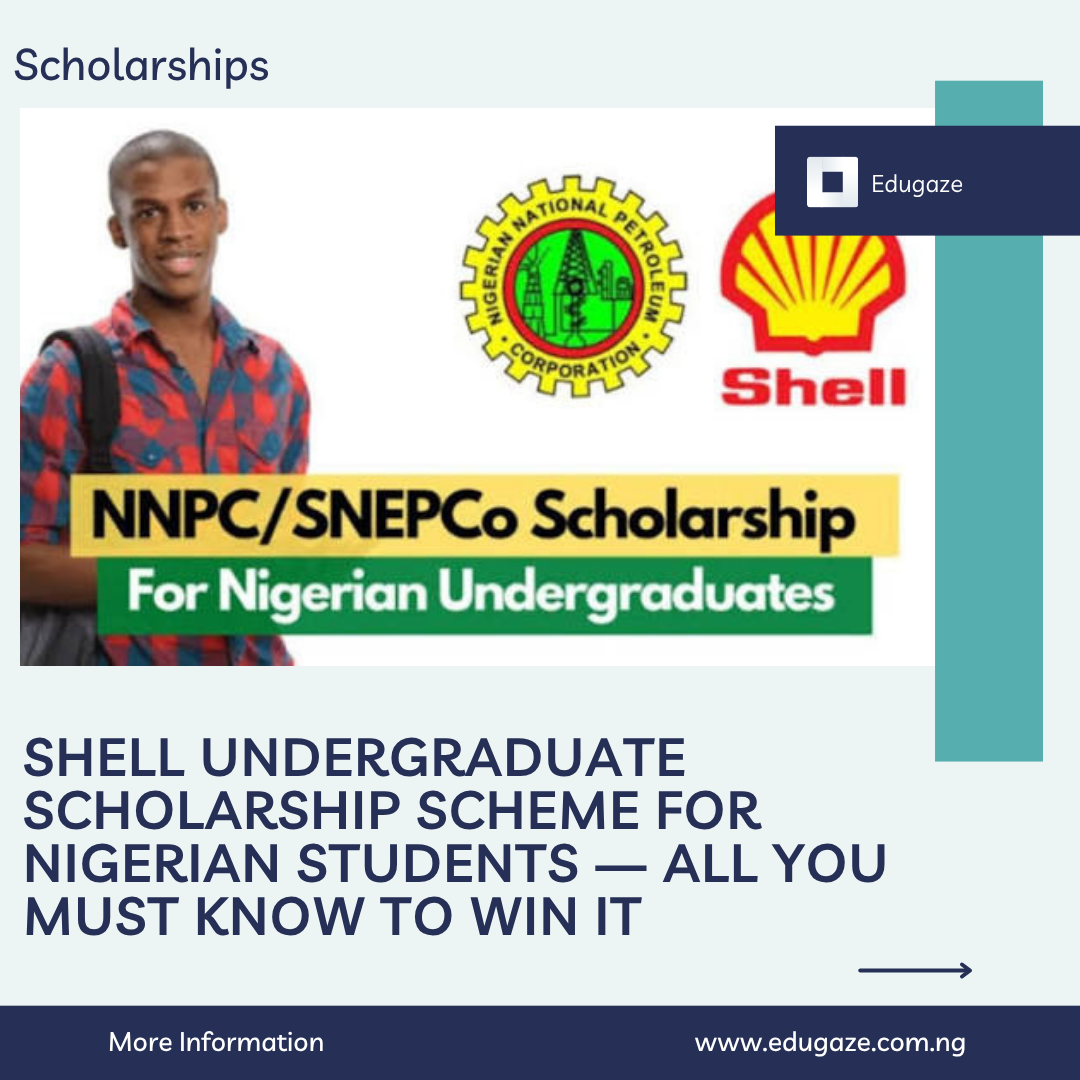
2. The NNPC/SNEPCo National University Scholarship This is a separate scheme operated by Shell Nigeria Exploration and Production Company (SNEPCo) on behalf of itself, NNPC, and other co-venturers (Esso/ExxonMobil, Nigerian Agip). It pays ₦250,000 per year and requires a minimum CGPA of 3.5 on a 5.0 scale — a significantly higher academic bar than the SPDC scheme. This scholarship is open to second-year (200 Level) students in public Nigerian universities.
3. The NNPC-SNEPCo Postgraduate Scholarship This is an entirely different programme for Master’s degree study in the UK (at the University of Aberdeen or Newcastle University), aimed at NYSC-completed graduates, not undergraduates.
This guide focuses on Scheme #1 — the SPDC JV University Scholarship — because it is the original, most well-known, and most widely applied-for “Shell scholarship” among Nigerian undergraduates. However, we will also point out the key differences from Scheme #2 throughout, because many students who think they applied for “the Shell scholarship” actually end up confusing the two schemes’ requirements — a mistake that can cost you the opportunity entirely.
What Is the Shell SPDC JV University Scholarship Scheme?
The Shell SPDC JV University Scholarship Scheme is a merit-based undergraduate scholarship programme funded by the Shell Petroleum Development Company of Nigeria Limited (SPDC), operating on behalf of the NNPC/SPDC/TotalEnergies/NAOC Joint Venture. It is part of Shell’s long-standing social investment programme in education in Nigeria — a commitment the company says dates back to 1952, shortly after Shell began operations in the country.
The scholarship’s stated objective is to develop Nigeria’s talent of the future, promote academic excellence, and improve the employability of young Nigerians — particularly those from less-privileged backgrounds. Historically, Shell has invested heavily in this programme: in 2014 alone, SPDC and SNEPCo together invested $14.8 million in scholarships, and by 2018 the figure was approximately $5.9 million (₦1.78 billion).
Every year, the scheme typically receives applications from over 16,000 Nigerian students, of whom roughly 4,000 are shortlisted to write the scholarship’s selection test. From that pool, a much smaller number are finally selected for the award. This tells you something important right away: this is a genuinely competitive scholarship, and you need a real strategy to stand a chance.
The Two Categories of the Shell SPDC JV Scholarship
This is a critical detail that determines your eligibility and your level of competition. The scholarship is divided into two distinct categories:
1. National Merit Award (NM)
This category is open to all Nigerian undergraduates, regardless of state of origin. Because it is open to literally every eligible Nigerian student in the country, this is by far the most competitive category. If you are not from one of Shell’s operational host states, this is the category you will apply under.
2. Areas of Operation Merit Award (OM)
This category is restricted to indigenes of SPDC’s operational areas — specifically Abia, Bayelsa, Delta, Imo, and Rivers States. Because the applicant pool for this category is much smaller (limited to just five states), your odds of success are meaningfully better if you qualify for it.
The detail almost no other blog explains properly: To apply under the Areas of Operation category, you do not just declare your state of origin — you must provide official documentary proof. Specifically, you need:
- A letter of identification confirming you are an indigene of your local community, stamped and signed by your community’s Paramount Ruler/Traditional Ruler
- A second letter from either the Chairman of your Community Development Committee (CDC) or your Community Executive Council (CEC)
Both letters must be addressed to: The Manager, Social Performance, The Shell Petroleum Development Company of Nigeria Limited (Shell), Shell Industrial Area, Port Harcourt, Rivers State
If you are eligible for the OM category and skip this documentation step, you will likely be defaulted into the more competitive National Merit Award category — or your application may be rejected outright. Start gathering these letters from your community leaders weeks before the application deadline, because traditional rulers and community leaders are not always immediately available, and getting these letters properly stamped and signed can take time.
Who Can Apply? — Full Eligibility Requirements
To qualify for the Shell SPDC JV University Scholarship Scheme, you must meet ALL of the following conditions:
- Must be a citizen of the Federal Republic of Nigeria
- Must be a registered, full-time undergraduate in an accredited and NUC-approved university in Nigeria
- Must be in 200 Level (second year) at the time of application, OR have proof of admission into an undergraduate programme for the relevant academic session if you are a first-year student awaiting progression
- Must have a minimum of five (5) O’Level credits, including Mathematics and English Language, from WAEC, NECO, or an equivalent body
- Must maintain a minimum CGPA — typically around 2.5 on a 5.0 scale for continued eligibility, though always confirm the exact current requirement on the official portal, as this figure can be adjusted between cycles
- Must NOT already be a beneficiary of any other scholarship from an entity in the Oil and Gas industry — whether national or international. This rule catches many students off guard, because they assume “any other scholarship” is fine as long as it is not also from Shell. It is not. If you are already receiving a scholarship from NNPC, TotalEnergies, ExxonMobil, Chevron, Seplat, or any other oil and gas company, you are disqualified from this scheme.
Important note on course of study: Unlike many corporate scholarships that restrict applicants to specific courses (such as Engineering or Geosciences), the Shell SPDC JV Scholarship has no course restrictions. Whether you are studying Law, Medicine, Mass Communication, Theatre Arts, Computer Science, or Agricultural Economics, you are equally eligible to apply. This is one of the most genuinely inclusive corporate scholarships in Nigeria in terms of academic discipline.
How Much Does the Shell SPDC JV Scholarship Pay?
The Shell SPDC JV Scholarship provides an annual grant of ₦150,000 to successful applicants. This amount is paid yearly, from your second year of study (200 Level) through to your final year, provided you maintain the required CGPA and continue meeting all eligibility conditions throughout your studies.
It is important to set realistic expectations here: this is not a fully funded scholarship in the sense of covering 100% of your tuition, accommodation, and living expenses at every Nigerian university. The ₦150,000 is intended as financial support toward your education costs — tuition, books, accommodation, and related expenses — rather than a complete cost-of-study package. At many public universities with lower tuition fees, this amount can meaningfully offset your costs. At private universities with higher fees, it will help but will not cover everything.
Do not confuse this with the NNPC/SNEPCo Scholarship, which pays ₦250,000 annually and has a stricter 3.5 CGPA requirement. Many students apply for one scheme thinking it is the other, and this confusion has led to disappointment when the actual award amount or requirements differ from what they expected.
Step-by-Step: How to Apply for the Shell SPDC JV Scholarship
Here is the complete, accurate application process based on how the scheme has consistently operated in recent cycles:
Step 1: Watch for the Official Announcement
Shell announces the opening of applications through its official Shell Nigeria website (shell.com.ng) and through major Nigerian news and education platforms. The application window has historically opened around June and closed in mid-July, though exact dates shift slightly each year. Always check the official Shell Nigeria sustainability/education page directly rather than relying solely on third-party blogs for dates, since blog post dates can be outdated by the time you read them.
Step 2: Access the Official Application Portal
Applications are processed exclusively through the Scholastica platform, with a URL structure similar to: https://candidate.scholastica.ng/schemes/[SPDC + relevant year code]
The exact link changes each cycle, so always navigate to it through the official Shell Nigeria website rather than searching for an old, possibly expired link.
Step 3: Register Using a Personal Email and Valid Phone Number
You will need a personal, active email address and a working phone number for consistent communication throughout the process. Shell uses these to notify shortlisted candidates, so check your email and SMS regularly once you have applied — including your spam/junk folder.
Step 4: Complete Your Personal, Educational, and Banking Information
Fill in your personal details, your educational background (university, course, level), and, in many cycles, your bank account information. Take your time here — accuracy matters significantly at this stage.
Step 5: Upload Your Required Documents
You will typically need to upload:
- A recent passport photograph with a white background, not more than three months old, in a specific format (commonly 450px by 450px, under 200KB)
- Your school ID card
- Your letter of admission from your university or JAMB (UTME or Direct Entry admission letter)
- For Areas of Operation applicants: your stamped and signed letters of identification from your community’s traditional ruler and CDC/CEC chairman
- A completed Government Official (GO) Declaration Form (available as a downloadable PDF from the application platform) — this form must be filled, signed, and re-uploaded
Critical document tip nobody else mentions: Make sure the name on every single document — your admission letter, your school ID, your O’Level result, and your application form — matches exactly and in the same order. A name appearing as “John Adeyemi Bola” on one document and “Bola John Adeyemi” on another is a common, avoidable reason applications get flagged or rejected during verification. If your name varies across documents for a legitimate reason (such as a name change or different naming conventions on different certificates), include a sworn affidavit explaining the discrepancy.
Step 6: Submit and Wait for Confirmation
Once submitted, you will receive an automated email and SMS confirming that your application was received. Keep this confirmation safe.
Step 7: Shortlisting Based on SSCE and JAMB Results
This is one of the most important and least understood parts of the entire process. According to Shell’s own stated process, applicants are shortlisted for the next stage based primarily on their combined national SSCE (WAEC/NECO) results and JAMB UTME scores.
This means your application’s success at this stage is determined before you even fill the form — by results you already obtained years earlier. If your O’Level grades and JAMB score were strong, you stand a much better chance of being shortlisted, regardless of how well-written your application form is.
The strategic insight most blogs never mention: Because shortlisting is based on academic results you cannot change retroactively, your energy as an applicant should go into making sure every other part of your application — documentation accuracy, eligibility compliance, and timely submission — is flawless. You cannot improve your old WAEC result, but you can absolutely lose your shot through a documentation error or a missed deadline, which are entirely within your control.
Step 8: The Aptitude Test (If Applicable)
Shortlisted candidates have historically been invited to sit a computer-based aptitude test at designated centres — commonly in Port Harcourt, Warri, Enugu, Lagos, and Abuja. Some recent cycles have reportedly modified or simplified this stage, so the exact format can vary year to year. Always read your shortlisting invitation email carefully, as it will specify exactly what is required of you, including the test centre and date.
If a test is required, you will be asked to bring hard copies of all your documents to the test venue, so prepare physical printouts in advance — do not assume a digital copy on your phone will be accepted.
Step 9: Reference Checks and Verification
Before any final award is made, Shell and its partner examination bodies conduct reference checks and background verification. This is also repeated after an award is made, as a re-verification step. This means honesty and accuracy throughout your application are not just ethical requirements — they are practically enforced.
Step 10: Award Notification
If you are selected, you will be contacted directly by the SPDC Scholarship Team, and you will receive the terms and conditions of your award along with a deadline for formal acceptance.
Critical Warnings Every Applicant Must Know
Shell has been explicit and consistent about the following warnings, year after year — and ignoring them has cost real students real money:
Shell does NOT charge any application fee. The entire process — from registration to final award — is completely free. If anyone asks you to pay money at any stage to “process,” “fast-track,” or “guarantee” your Shell scholarship application, it is a scam. Report it and walk away.
Shell does NOT use agents or representatives. No one is authorised to act on Shell’s behalf to help you “secure” a scholarship slot, including people claiming to work at Shell offices, “scholarship consultants,” or social media accounts claiming insider access. The only legitimate channel is the official Shell Nigeria website and the linked Scholastica application portal.
Applications must be submitted only through the official portal, accessed via the Shell Nigeria website. Be very cautious of links shared on WhatsApp groups, Telegram channels, or random websites claiming to be the “Shell scholarship application link” — always verify against the official Shell Nigeria site before entering any personal information.
Use a desktop or laptop, not a mobile phone, for your application. Several past application cycles have explicitly required that registration be completed on a desktop or laptop system, as the platform may not function correctly on mobile browsers. If you do not have personal access to a computer, visit a cybercafé or borrow one rather than risk an incomplete mobile submission.
The Unique Strategic Advantage Most Applicants Miss
Here is something that almost no scholarship blog explains, and it could genuinely improve your odds: the Shell SPDC JV Scholarship explicitly favours students from less-privileged backgrounds as part of its stated objective. The scholarship documentation specifically states that it aims to promote academic excellence “particularly” among young Nigerians from less-privileged backgrounds.
This means that in your application — wherever there is room for additional context, a personal statement, or supporting information — clearly and honestly communicating your financial circumstances, your family background, and what this scholarship would mean for your continued education can meaningfully strengthen your application profile. Do not exaggerate or fabricate anything (remember, verification checks happen both before and after the award), but do not hide a genuine financial need either. Authenticity here works in your favour.
Additionally, since the scholarship is renewable every year through to graduation, contingent on maintaining your CGPA, your application is not a one-time event — it is the start of a multi-year relationship. This means consistency matters: once you win, your continued discipline in your academic work is what keeps the funding flowing for the rest of your degree.
Common Mistakes That Disqualify Applicants
Based on the patterns seen across multiple application cycles, here are the most frequent — and most avoidable — mistakes:
Applying while already on another oil and gas scholarship: This single rule disqualifies more applicants than almost any other factor, because many students do not realise their existing NNPC, TotalEnergies, or local state-oil scholarship makes them ineligible for the Shell scheme.
Mismatched names across documents: As explained above, inconsistent name formatting between your admission letter, O’Level certificate, and application form is a very common and entirely avoidable rejection reason.
Missing or improperly notarised Areas of Operation letters: Applicants who qualify for the OM category but submit unstamped, unsigned, or improperly addressed community letters often get pushed (sometimes incorrectly assessed) into the more competitive National Merit category, or have their application flagged.
Applying after the deadline: Because the exact deadline shifts year to year, some students rely on outdated information from old blog posts (sometimes a full year out of date) and miss the actual current deadline. Always cross-check with the official Shell Nigeria website before finalising your plans.
Falling for fake “past questions” sellers: A number of websites sell “Shell scholarship aptitude test past questions” for a fee, despite at least one official statement indicating that Shell may no longer conduct the same style of aptitude test in every cycle. Be cautious about paying for test preparation material from unverified sources — confirm directly from your shortlisting email what the actual selection process for your specific cycle involves before spending money on prep material.
Frequently Asked Questions (FAQs)
Q1: What is the Shell SPDC JV Undergraduate Scholarship Scheme? It is a merit-based scholarship funded by Shell Petroleum Development Company of Nigeria Limited (SPDC), offering an annual grant to qualifying Nigerian undergraduates from their second year through to graduation, provided they maintain the required academic standing.
Q2: How much does the Shell SPDC JV Scholarship pay? The scholarship pays ₦150,000 annually. This is different from the separate NNPC/SNEPCo Scholarship, which pays ₦250,000 per year under different eligibility requirements.
Q3: What is the difference between the Shell SPDC JV Scholarship and the NNPC/SNEPCo Scholarship? The SPDC JV Scholarship is open to undergraduates in any accredited Nigerian university and pays ₦150,000 annually, with a CGPA requirement around 2.5. The NNPC/SNEPCo Scholarship is open to students in public universities only, pays ₦250,000 annually, and requires a much higher minimum CGPA of 3.5. They are administered by different Shell-related entities and have separate application portals.
Q4: Who can apply for the Areas of Operation Merit Award? Only Nigerian undergraduates who are indigenes of Abia, Bayelsa, Delta, Imo, or Rivers States — Shell’s designated operational areas — can apply under this category, provided they submit properly stamped letters of identification from their traditional ruler and Community Development Committee or Executive Council.
Q5: Does Shell charge any fee to apply for this scholarship? No. The application is completely free at every stage. Shell does not charge processing fees, and anyone asking for payment to assist with your application is attempting to scam you.
Q6: Can I apply if I am already receiving another scholarship? You can apply if your existing scholarship is not from an entity in the Oil and Gas industry. However, if you are already a beneficiary of a scholarship from any Oil and Gas company — Nigerian or international — you are not eligible for the Shell SPDC JV Scholarship.
Q7: Is there a specific course requirement for this scholarship? No. Unlike many corporate scholarships that restrict eligibility to specific courses like Engineering or Geosciences, the Shell SPDC JV Scholarship is open to undergraduates in any course of study, at any NUC-accredited Nigerian university.
Q8: How are applicants shortlisted for the aptitude test? Shortlisting is based primarily on a combination of your national SSCE results (WAEC/NECO) and your JAMB UTME score. This means your existing academic records significantly influence whether you even reach the testing stage.
Q9: Is the scholarship renewable every year? Yes. Once awarded, the scholarship is renewable annually through to graduation, provided you maintain the required CGPA and continue to meet the eligibility conditions throughout your degree programme.
Q10: Where is the official application portal? Always access the application exclusively through the official Shell Nigeria website (shell.com.ng), which links to the Scholastica application platform for the current cycle. Never use links shared through unofficial social media pages or unsolicited messages.
Final Words
The Shell SPDC JV Undergraduate Scholarship Scheme is one of Nigeria’s oldest, most established, and most widely recognised corporate scholarship programmes — a programme that has quietly supported the education of tens of thousands of Nigerian undergraduates since the 1960s. It is genuinely achievable, genuinely free to apply for, and genuinely open to students from every course of study and (with the right documentation) from Shell’s host communities specifically.
The biggest advantage you now have, after reading this guide, is clarity — clarity on which Shell scholarship you are actually applying for, clarity on the exact eligibility rules that disqualify many applicants without their knowledge, clarity on how shortlisting actually works, and clarity on the documentation details that quietly determine success or failure for thousands of applicants every year.
Use this clarity. Gather your documents early — especially your community letters if you qualify for the Areas of Operation category. Confirm the current cycle’s exact deadline directly from the official Shell Nigeria website. Triple-check that your name is consistent across every document. And apply with confidence, knowing exactly what you are walking into.
Good luck — and may this be the scholarship that lightens your financial load all the way to graduation.
Keep visiting our blog for the latest scholarship opportunities, admission updates, and education tips across Nigeria.
About the Author