Stellenbosch University MSc in Machine Learning and AI 2027 — Application Open Now (Full Guide)
If Artificial Intelligence and Machine Learning are the careers of the future — and they absolutely are — then the question is not whether you should build deep expertise in these fields, but where and how you should do it. For anyone on the African continent asking that question seriously in 2026, one programme deserves your full attention right now: the MSc in Machine Learning and Artificial Intelligence at Stellenbosch University in South Africa.
And here is the most important piece of information in this entire guide: applications for the 2027 intake are currently open, and a first round of selections is happening in August/September 2026. If you apply before 15 August 2026, you will not only be in the first selection round — you will also be automatically considered for the full scholarships available to students from Africa that the programme manages. If you wait until after 15 August, you lose both of those advantages.
This is a genuinely exceptional programme, on a genuinely respected continent-class campus, with a genuinely accessible application process. This guide will walk you through everything — what the programme covers, exactly who qualifies, how to apply step by step, what it costs, and how to maximise your chances of getting a scholarship. Read it completely and then go straight to the application portal.
About Stellenbosch University and Why This Programme Matters
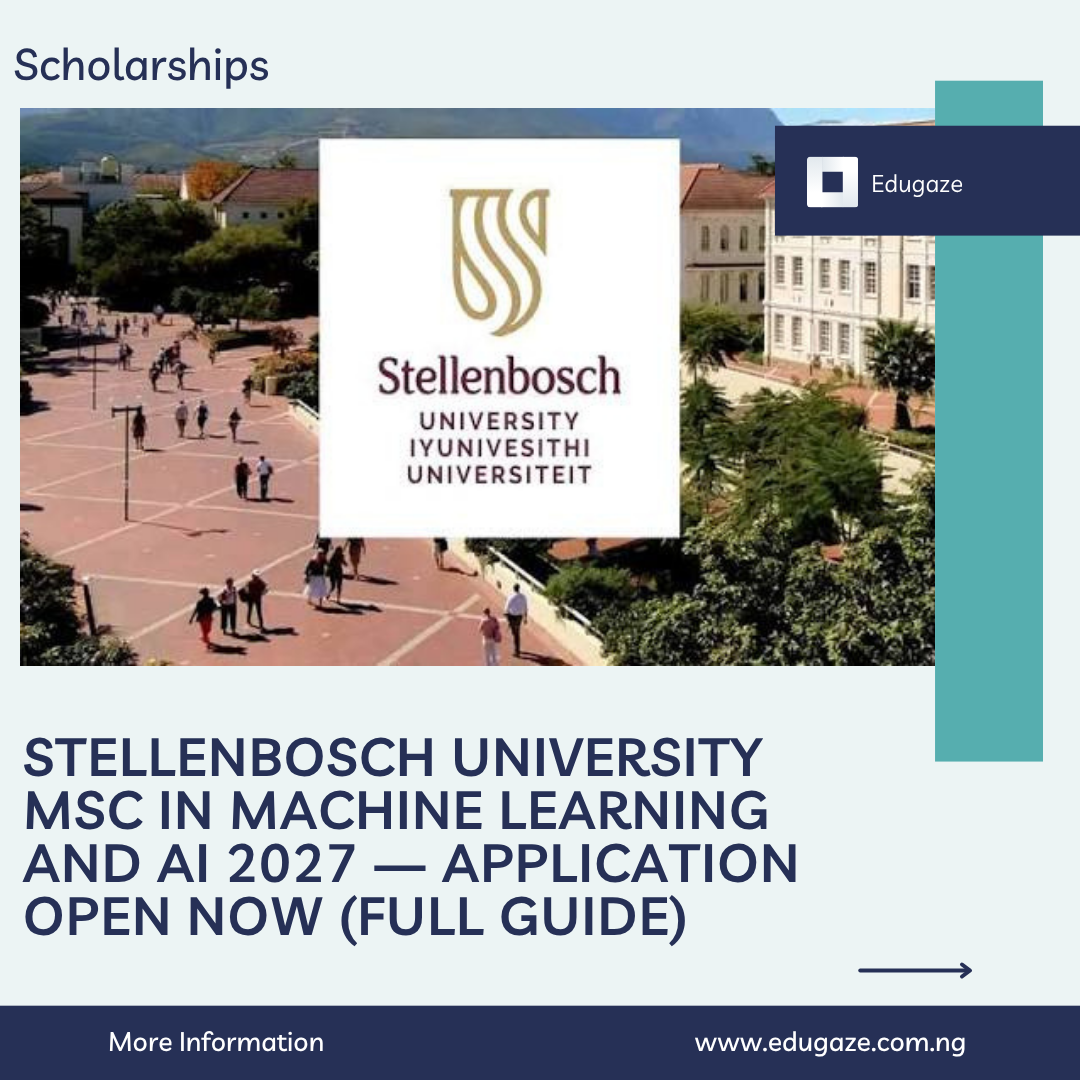
Stellenbosch University is one of Africa’s most research-intensive and globally respected universities. Located in the beautiful Winelands town of Stellenbosch, about 50 kilometres from Cape Town in South Africa, it is consistently ranked among the top five universities on the African continent and among the top 400 universities in the world.
The university has a particularly strong reputation in applied mathematics, engineering, computer science, and data science — which is exactly why the Faculty of Science at Stellenbosch is the natural home for a dedicated Machine Learning and AI Master’s programme of this calibre.
The MSc in Machine Learning and Artificial Intelligence (MLAI) is described by the programme itself as being designed for students with a strong mathematical and computational background, with the goal of equipping them with both the fundamentals of ML and AI and a suite of sophisticated techniques and concepts at the research frontier of these fields.
This is not a business-oriented “AI strategy” programme or a high-level overview course. It is a mathematically rigorous, technically demanding, research-oriented postgraduate programme — the kind that produces people who actually build AI systems, not just talk about them.
Why this matters for African students specifically: Most world-class AI Master’s programmes are located in the United States, United Kingdom, or Europe — places where international students often face very high tuition costs, complex visa processes, and living expenses far above what most African students can manage even with partial funding. Stellenbosch offers a world-class AI programme on the African continent, with living costs that are dramatically lower than London or Boston, with scholarships specifically reserved for African students, and with a campus environment that is safe, vibrant, and internationally connected.
For Nigerian students, Kenyan students, Ghanaian students, and graduates from across Africa who have the mathematical and computational foundation to qualify — this is one of the most accessible pathways to a globally competitive AI qualification.
Programme Overview — What the MSc MLAI Offers
The MSc in Machine Learning and Artificial Intelligence at Stellenbosch University is a one-year structured Master’s programme (with an option for part-time study over two years). It runs from January to December each year, entirely on-campus at Stellenbosch University.
The programme is worth 180 credits in total and is structured around three sequential blocks:
Block 1: Core Modules (15 credits each — 4 compulsory modules)
These are the foundational modules every student must complete, regardless of their chosen electives. They establish the mathematical and conceptual backbone for everything else in the programme:
Mathematics for Machine Learning A comprehensive review of fundamental mathematical concepts as tools of the ML and AI trade. Topics include relevant areas of linear algebra, multivariate calculus, optimisation, and mathematical statistics. This module ensures all students are working from the same strong mathematical foundation before advancing to more complex material.
Probabilistic Modelling and Reasoning Covers probability theory, marginalisation, sum-product decomposition, Markov blankets, classic hidden Markov models, expectation maximisation, probabilistic graphical models, data completion, and information theory. This module builds the probabilistic thinking that underlies most modern AI systems.
Foundations of Deep Learning The basics of deep learning as a precursor for more advanced modules. A recap of ML fundamentals, followed by topics specific to deep neural networks — including gradient-based training, common architectures, autoencoders, and generative models. This is the gateway to understanding the technology behind ChatGPT, image generation, and other frontier AI tools.
Applied Machine Learning at Scale This module examines how ML is applied to internet-scale systems — the kind of systems used by the world’s largest tech companies. Topics include A/B testing, ranking, recommender systems, modelling of users and online content (like news stories), and network effects. This module bridges the gap between theory and real-world deployment at massive scale.
Block 2: Elective Modules (10 credits each — must complete 6 from the list)
After the core block, students select six elective modules from a menu of specialised topics. Not all electives are offered every year (availability depends on lecturer availability), and the list for 2027 will be communicated to successful applicants. The current elective offerings include:
Computer Vision A study of convolutional neural networks for popular computer vision applications — image classification, object detection, semantic segmentation, style transfer, image captioning, and image generation. This is the AI behind facial recognition, self-driving cars, and medical imaging.
Natural Language Processing (NLP) Word embeddings, part-of-speech tagging, syntactic parsing, topic modelling, language modelling with recurrent and convolutional neural networks, machine translation with seq2seq models and attention, and sentence classification. This is the technology behind language models like GPT and translation tools.
Reinforcement Learning and Planning Decision and control theory, exploration, Q-learning and policy gradients, hierarchical RL, Markov decision processes, model-based RL, multi-agent RL, planning and navigation. This is the AI behind game-playing systems (AlphaGo) and autonomous robotics.
Sequence Modelling Techniques to model and predict temporally varying data — including financial data, weather, audio, and video. Covers state-space models, hidden Markov models, recurrent neural networks (RNNs), long short-term memory (LSTM) gates, and the Transformer model. The Transformer architecture is the foundation of most modern AI language models.
Advanced Probabilistic Modelling Restricted Boltzmann machines, approximate inference techniques for probabilistic graphical models (belief propagation, variational inference), Bayesian non-parametric models (Gaussian and Dirichlet processes), and collapsed Gibbs sampling.
Optimisation for Machine Learning Convex optimisation in high-dimensional space, stochastic mini-batch gradient descent, momentum, Nesterov theory, and practical methods like RMSProp and Adam. Advanced topics including conjugate exponentials and stochastic variational inference may also be covered.
Monte Carlo Methods Approximation techniques for statistical inference in ML — including Metropolis-Hastings, Gibbs sampling, importance sampling, slice sampling, and exact sampling. Techniques for normalising constants, annealing, and thermodynamic integration may also be covered.
Artificial Intelligence and the Brain A fascinating exploration of neuroscience topics that inspire AI research — Hebbian learning, simple perceptrons, the canonical microcircuit, predictive coding, dopamine-coded reward prediction, hippocampal feedback, the visual hierarchy, and the auditory processing system. This module bridges AI and cognitive neuroscience.
Advanced Topics I and II Two reserved elective slots for cutting-edge topics at the frontier of ML and AI research — topics that do not fit into any of the other standard modules but are too important and current to leave out.
Block 3: Research Project (60 credits)
The final block — worth the largest single chunk of credits in the entire programme — is an individual research project conducted under the guidance of an academic supervisor.
The project requires:
- Formulating clear research objectives
- Conducting a thorough survey of the relevant academic literature
- Applying what was learned throughout the modules to a real research problem
- Evaluating results critically and rigorously
- Producing a high-quality conference or journal-style paper as the final output
- Delivering an oral presentation of research findings
This research project is what truly elevates the MLAI programme beyond a taught course. Completing it means you have not just learned about AI — you have actively contributed to the knowledge base of the field. The research paper output is also a powerful credential for anyone who wants to continue into PhD studies or take on a research-oriented role in industry.
Important note for applicants: You do not need to identify an academic supervisor before applying. Accepted students have an opportunity after the start of the programme to speak to potential supervisors and indicate their research project preferences. This removes one of the biggest hurdles in traditional research degree applications.
Who Can Apply? — Admission Criteria
The MSc MLAI at Stellenbosch has clear and specific admission requirements. As a minimum, you must hold one of the following qualifications by the time of enrolment (January 2027):
- An Honours degree in Applied Mathematics, Computer Science, Mathematics, or Mathematical Statistics
- A four-year Bachelor’s degree in Engineering (from a recognised institution)
- An NQF level 8 qualification (or international equivalent) deemed equivalent to the above, in a field closely linked to ML and AI
For Nigerian applicants and other African students specifically: your four-year Bachelor’s degree in Computer Science, Mathematics, Statistics, or Engineering from a Nigerian university (UNILAG, UI, OAU, FUTA, FUTO, ABU, etc.) is likely to be evaluated as an NQF level 8 equivalent, provided the degree is from an accredited institution and your academic performance was strong. Degrees from accredited polytechnics and universities of technology may also be considered — the programme explicitly notes that qualifications will be “evaluated against the South African system.”
Beyond the degree, you should also have:
- Demonstrable proficiency in Python or an equivalent programming language — this is explicitly stated as a requirement. You must be able to write Python code confidently before starting the programme.
- Comfort with numerical linear algebra, vector calculus, basic probability theory, and statistics
- It is highly recommended (though not strictly required) that you have already completed an introductory course on machine learning before applying
Selection process: Due to capacity limitations, a selection committee gives final approval for all admissions. Preference is given to students with higher academic marks and with prior studies that are better aligned with the programme’s specialisation. This means both your degree result and the relevance of what you studied will be considered when the committee reviews your application.
Scholarships — The Most Important Section for African Students
This is the section that could change everything for you — and it is directly from the programme’s official FAQ page, which means it is current and reliable.
Yes, there are full scholarships available specifically for students from Africa.
According to the official MLAI programme website: “We usually have a small number of full scholarships available for students from Africa. If you complete an application for the programme before 15 August, you will be considered for the scholarships that we manage.”
Let us be very clear about what this means and why it matters:
A full scholarship means the entire programme cost is covered — tuition fees and related costs — for the students who receive it. For African students who cannot self-fund international study, this scholarship is the key that makes the MLAI programme financially accessible.
The 15 August deadline is the scholarship deadline, not the general application deadline. The overall applications close on 31 October 2026. But to be considered for the internal scholarships managed by the programme, you must submit your complete application by 15 August 2026. If you apply after 15 August, you will still be considered for the programme itself (provided space remains) — but you will have missed consideration for the programme’s own scholarship pool.
External scholarships also support this programme. The official MLAI FAQ specifically mentions the Queen Elizabeth Commonwealth Scholarships (QECS) as an external scholarship that supports this programme. In fact, Stellenbosch University is one of the QECS host institutions — meaning Nigerian and other Commonwealth students who win a QECS award can use it to fund the MLAI programme. The QECS closing date for the relevant cycle was 3 June 2026 — if that window has passed, watch for the next cycle opening in November 2026.
Key Dates for the 2027 Intake
These are the confirmed dates directly from the official programme website:
| Event | Date |
|---|---|
| Applications now open | Applications for 2027 are currently open |
| Scholarship consideration deadline | 15 August 2026 |
| First round notifications | August / September 2026 |
| Final application deadline | 31 October 2026 |
| Second round notifications | November 2026 |
| Programme start | Mid-January 2027 |
The strategic insight the programme itself gives you: Apply early if you can. The programme explicitly states: “A first round of selections and notifications will happen in August/September, so apply early if you can! Please keep in mind that space is limited.”
Space is limited, selections happen in multiple rounds, and the best candidates (and the scholarship pool) go in the first round. Every week between now and 15 August that you delay your application is a week of competitive disadvantage.
Step-by-Step: How to Apply for the Stellenbosch MLAI Programme
Here is the complete, accurate application process taken directly from the official MLAI website:
Step 1: Go to the SUNStudent Applicant Portal
Visit the Stellenbosch University SUNStudent applicant portal at: https://student.sun.ac.za/applicant-portal/
Create a profile if you do not already have one, and log in.
Step 2: Select the Correct Programme
Click on “Programme selection” and navigate using the following filters:
- Faculty: “Faculty of Science — Stellenbosch”
- Programme type: “Postgraduate”
- Programme: “MSc (Machine Learning and Artificial Intelligence)” — select either full-time or part-time depending on your circumstances
Step 3: Complete the Required Personal and Academic Information
Work through the menus on the left panel of the portal to fill in all required information — personal details, academic history, contact information, and referee details.
Step 4: Upload Your Required Documents
Under the “Upload documents” section, you will need to upload:
A comprehensive CV Your CV should clearly highlight your academic background, your programming experience (especially Python), any ML or AI coursework you have completed, research experience, and any relevant work experience in data science, software engineering, or related fields.
A letter of motivation This can be short (approximately 1 page). It should cover three things: why you want to complete this programme, what you hope to get out of it, and what you might want to do after the programme. Be specific and genuine — do not write generic statements about “passion for AI.” Tell them specifically what draws you to ML and AI and what you plan to do with this qualification.
A statement of research interest Also approximately 1 page. This is an opportunity to outline any specific interests you currently have within the fields of ML and AI. Do not worry if your interests are not fully formed — even a genuinely curious outline of what excites you about a particular sub-field (computer vision, NLP, reinforcement learning, etc.) is appropriate and useful.
Step 5: You Do NOT Need to Find a Supervisor
This is confirmed directly in the official application guidelines: you do not need to identify an academic supervisor to apply. Accepted students will have the opportunity after the programme starts to speak to potential supervisors and indicate research project preferences.
This removes one of the most common barriers that deters applicants from research degree programmes — not knowing which professor to approach or how to initiate that relationship.
Step 6: Submit Your Application
Once you are satisfied that everything is complete and accurate, submit your application. Note that there may be a small application fee — check the portal at the time of submission for the current amount.
Official application portal: https://student.sun.ac.za/applicant-portal/ Official programme website: https://mlai.sun.ac.za/ Contact the programme coordinator: Prof. Willie Brink — wbrink@sun.ac.za
Full-Time vs Part-Time — Understanding Your Options
Full-time (1 year): The programme runs from January to December. Full-time students typically take two modules at a time, with each module having two to three contact sessions (lectures or practicals) per week on the Stellenbosch campus.
Part-time (2 years): The part-time option allows students to complete the same programme over two years. Part-time students work out — in consultation with the programme coordinator — how best to split their modules and research project across the two years. One common approach is to complete half the modules in year 1 and the remaining modules plus the research project in year 2.
Important: The programme is presented entirely in person on the Stellenbosch campus. There is no online or remote option. You must be physically present in Stellenbosch for the duration of your studies. Factor in relocation costs and accommodation in Stellenbosch when planning your financial arrangements.
What Does the Programme Cost?
The official MLAI website does not publish a fixed tuition figure, because Stellenbosch University fees can vary depending on your citizenship status (South African, SADC, or international) and are adjusted annually. Instead, the programme directs applicants to generate a provisional fee quote using the Stellenbosch University fee quotation tool:
https://student.sun.ac.za/fees-quotation/#/home
For general information on online application processes, study fees, and support services, Stellenbosch University’s main postgraduate studies page is: https://www.su.ac.za/en/apply/pg-studies
For international and African students from outside South Africa, the programme’s full scholarships — when available — cover these fees entirely. Pursuing the scholarship by applying before 15 August 2026 is therefore the most financially strategic move for any non-South African applicant.
Who Is Conditionally Accepted? — Important for Final-Year Students
This is a feature of the application process that is particularly relevant for Nigerian students who are currently in their final year of their undergraduate or Honours degree:
If you will only complete your current degree at the end of 2026, you can still apply for the 2027 intake.
The programme explicitly confirms this: “You can submit an application with the information and transcripts you have on hand. There will be a ‘conditionally accepted’ option, that may admit a student on the condition that they will have completed their degrees by January 2027.”
This means you do not need to wait until you have your final results or degree certificate in hand before applying. Apply now with your current transcripts, indicate your expected graduation date, and if the selection committee finds your application strong, you can receive a conditional offer that becomes confirmed once your degree is complete.
Why This Programme Stands Out — For African Students Especially
There are a few features of this programme that are worth naming explicitly, because they collectively make it more practically attractive for African applicants than many alternative AI Master’s programmes at more famous institutions:
The Africa scholarship pool: Having full scholarships reserved specifically for African students is not common at postgraduate level, even among African institutions. This is a deliberate and meaningful commitment by the programme to making world-class AI education accessible on the continent.
No supervisor required at application stage: This lowers the entry barrier significantly compared to traditional research degrees where finding and securing a supervisor before applying is a complex prerequisite.
A genuinely research-oriented programme: The 60-credit research project and the requirement to produce a conference or journal-quality paper means this degree is a real research credential — not just a coursework certificate. For anyone targeting a PhD or a research role in AI, this is invaluable.
The location: Stellenbosch is a safe, affordable, internationally connected university town. The cost of living in Stellenbosch is dramatically lower than studying in London, Amsterdam, or Boston. For self-funded students or those on partial awards, this cost difference is substantial.
External scholarship links: The programme actively flags external scholarships (like the QECS) that students can pursue to fund their studies — showing a genuine commitment to supporting students’ financial planning rather than assuming everyone can self-fund.
Frequently Asked Questions (FAQs)
Q1: Is the Stellenbosch MLAI programme fully funded? There are a small number of full scholarships for African students managed by the programme itself. To be considered, you must submit a complete application by 15 August 2026. External scholarships like the Queen Elizabeth Commonwealth Scholarships (QECS) also support this programme.
Q2: Can I do this programme online or remotely? No. The programme is presented in person only at Stellenbosch University. There is no remote or online option.
Q3: Do I need to find an academic supervisor before applying? No. You do not need to identify or secure an academic supervisor before submitting your application. Accepted students arrange supervision after the programme begins.
Q4: I am currently in my final year. Can I still apply for 2027? Yes. You can apply with your current transcripts and be conditionally accepted, with the condition that you complete your degree by January 2027.
Q5: When will I hear back about my application? If you apply before 15 August 2026, you will be notified in August or September 2026. If you apply between 15 August and 31 October 2026, you will be notified in November 2026.
Q6: What programming language do I need to know? Python or an equivalent language. You must have existing, demonstrable proficiency in Python before starting the programme. If you are not yet fluent in Python, begin learning now — there are excellent free resources including Python.org, freeCodeCamp, and Coursera’s Python for Everybody course.
Q7: What is the application deadline for 2027? The final deadline is 31 October 2026. However, the scholarship deadline is 15 August 2026 and the first selection round also happens based on applications received before that date. Apply before 15 August for the strongest possible positioning.
Q8: Who is the programme coordinator and how can I contact them? The programme coordinator is Prof. Willie Brink, Department of Applied Mathematics, Stellenbosch University. You can reach him at: wbrink@sun.ac.za
Q9: What is the difference between the full-time and part-time options? Full-time students complete all core modules, six electives, and the research project in one year (January to December). Part-time students complete the same content over two years, splitting modules and the research project in consultation with the programme coordinator.
Q10: Can I attend the lectures if I am already a research student at Stellenbosch? Yes. If you are already a research Master’s or PhD student at Stellenbosch University, you can contact the programme to find out how to attend the MLAI lectures.
Our Final Advice
The MSc in Machine Learning and Artificial Intelligence at Stellenbosch University is a programme that deserves far more attention from ambitious African graduates than it currently receives. It is rigorous enough to be taken seriously by employers and PhD programmes globally. It is located on one of Africa’s most respected campuses. It has scholarships specifically reserved for African students. It does not require you to have already found a supervisor. And applications for the 2027 intake are open right now.
If you have an Honours degree, a four-year Engineering degree, or equivalent NQF level 8 qualification in a mathematically relevant field, and you can demonstrate Python proficiency and comfort with linear algebra and statistics — this programme was built for someone exactly like you.
The scholarship deadline is 15 August 2026. The general deadline is 31 October 2026. Do not delay.
👉 Apply here: https://student.sun.ac.za/applicant-portal/ 👉 Full programme details: https://mlai.sun.ac.za/ 👉 Contact the coordinator: wbrink@sun.ac.za
Keep visiting our blog for the latest scholarship opportunities, postgraduate study guides, and education tips across Africa and the world.
About the Author