Fully Funded PhD Opportunity at Lancaster University CASS Research Centre 2026 – £20,780 Annual Stipend for UK and International Students (Apply Now)
If you are a linguistics graduate with a passion for language research, data analysis, and making a real-world difference through academic inquiry, then this fully funded PhD opportunity at one of the UK’s top universities is exactly what you have been waiting for.
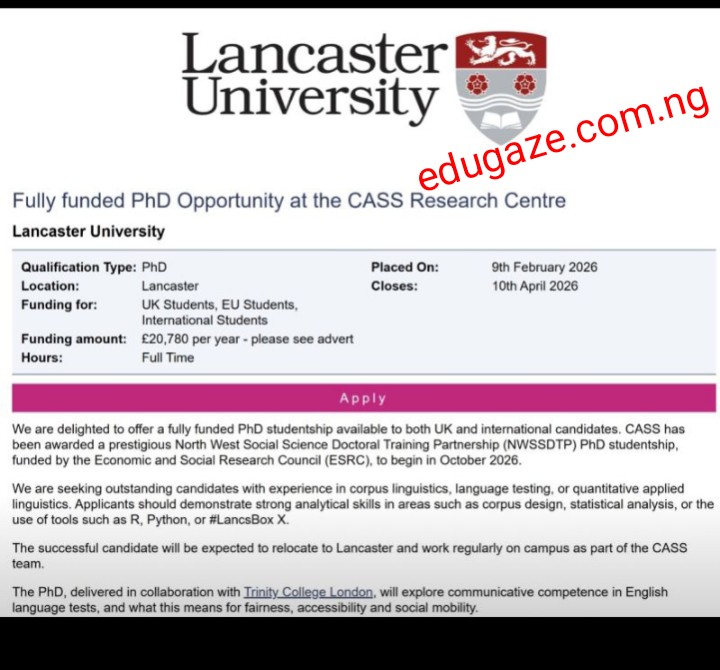
Lancaster University’s Centre for Corpus Approaches to Social Science (CASS) is offering a prestigious, fully funded PhD studentship open to both UK and international candidates, starting October 2026. This is not just another PhD position — it is a career-defining opportunity to conduct groundbreaking research at the intersection of corpus linguistics, English language assessment, social equity, and applied social science, in collaboration with Trinity College London, one of the world’s leading awarding bodies for English language qualifications.
With a tax-free annual stipend of £20,780, full tuition fee coverage, and the backing of the Economic and Social Research Council (ESRC) — one of the UK’s most prestigious research funding councils — this studentship represents one of the most complete and well-supported PhD packages available to linguistics researchers globally.
Read this article carefully. Everything you need to know — the research topic, funding details, eligibility, supervisors, and the direct application links — is right here.
About Lancaster University
Before we dive into the specifics of this PhD opportunity, it is worth understanding the calibre of institution offering it.
Lancaster University is one of the United Kingdom’s most respected research universities. It consistently ranks among the top 10 universities in the UK in major national league tables and is globally recognised for the quality of its research output, teaching excellence, and graduate employability. Lancaster received a Gold rating in the UK’s Teaching Excellence Framework (TEF) — the highest possible recognition for teaching quality — and its research has been rated as world-leading across multiple disciplines.
Located in the picturesque city of Lancaster in North West England, the university offers a beautiful, self-contained campus that gives students a genuine community experience. For international students, Lancaster is a welcoming, safe, and vibrant university city with excellent transport connections across the UK.
Most importantly for this PhD opportunity, Lancaster is home to the Department of Linguistics and English Language — widely regarded as one of the best linguistics departments in the world — and the CASS Research Centre, which has established itself as a globally leading hub for corpus-based research in the social sciences.
About the CASS Research Centre
The Centre for Corpus Approaches to Social Science (CASS) is an ESRC-funded research centre at Lancaster University dedicated to applying corpus linguistics — the use of large, computer-searchable collections of authentic language data — to questions that matter in the social sciences and beyond.
CASS researchers work at the frontier of how language data can illuminate social phenomena: from media representations of public figures and institutions, to how language is used in legal, medical, and educational contexts. The centre has built an outstanding international reputation for methodological innovation, high-impact research, and collaborative work with major organisations including the British Council.
This PhD studentship is offered as part of CASS’s prestigious North West Social Science Doctoral Training Partnership (NWSSDTP) award — a highly competitive grant given by the ESRC to support the next generation of outstanding social science researchers in the North West of England.
The PhD Research Project — What Will You Be Investigating?
This is where things get genuinely exciting. The PhD has a specific, clearly defined, and socially important research focus:
“Communicative Competence in Action: A Corpus-Based Analysis of Speaking and Writing Tasks for the Next Generation of English Language Assessment”
At its heart, this project asks a fundamental and high-stakes question: What does successful communication actually look like in real spoken and written English? And critically — how well do current English language tests actually capture it?
English language tests are used every day to make life-changing decisions about people’s access to education, employment, and immigration. Whether someone gets into a university, is granted a visa, or qualifies for a professional role can hinge on their performance in these assessments. This PhD project sits right at the intersection of test validity and social equity — two issues that are not only academically rich but have profound real-world consequences.
The research will be delivered in collaboration with Trinity College London, giving the PhD student direct access to real-world assessment data, industry-level expertise, and a prestigious international partner organisation.
Research Questions the PhD Will Explore
The project has three central research questions:
Research Question 1: What linguistic and discourse features characterise successful spoken and written communication across informal, semi-formal, and formal (academic) contexts?
Research Question 2: Which test tasks best elicit the richest range of these communicative features — and therefore most accurately measure genuine ability?
Research Question 3: How do linguistic patterns in test performance correlate with candidates’ social backgrounds — and what does this reveal about the overall fairness and accessibility of English language assessments?
These questions place this PhD at the crossroads of corpus linguistics, applied linguistics, language testing, and social justice — a combination that is not only intellectually stimulating but urgently needed in both academic and policy circles.
Funding Details — What Does This Studentship Cover?
This is a fully funded PhD studentship in the truest sense. Here is a complete breakdown of what successful candidates will receive:
Full Tuition Fee Coverage Your complete PhD tuition fees are covered for the full duration of the programme — for both UK-fee and international-fee students. Lancaster University has confirmed that it will fund the difference between home and overseas tuition rates for any successful international applicant. This means international students are not disadvantaged financially — you pay nothing in tuition.
Tax-Free Annual Maintenance Stipend Successful candidates receive a tax-free living allowance of £20,780 per year — currently set at the standard ESRC/UKRI stipend rate. This stipend is paid regularly throughout your studies to cover your living costs in Lancaster, including accommodation, food, transport, and daily expenses.
Research Training Support As part of the NWSSDTP, funded students also benefit from research training grants and professional development opportunities — equipping you with the advanced methodological skills needed to become a world-class researcher.
Advanced Training in Cutting-Edge Methods The studentship includes advanced training in corpus linguistics, quantitative and qualitative analysis, and applied research in high-stakes assessment contexts — training that is directly relevant to both academic and industry careers.
This is a comprehensive funding package that allows you to focus entirely on your research without financial worry.
Who Are the Supervisors?
One of the most important factors in any PhD journey is the quality of supervision. This studentship puts you in excellent hands.
Professor Vaclav Brezina is a globally recognised expert in corpus linguistics, language learning and teaching research, and statistical methods for language analysis. He is one of the key architects behind #LancsBox X, one of the most widely used corpus analysis software tools in the world, and has published extensively in top-ranked linguistics journals. His supervision will give you access to world-class expertise in computational and quantitative approaches to language.
Dr Dana Gablasova is a highly regarded researcher in second language acquisition, spoken language corpora, and language testing research. Her work on large-scale spoken language datasets and their implications for language learning and assessment is internationally cited and directly relevant to this PhD project.
Together, these two supervisors offer a powerful combination of corpus methodology expertise and applied linguistics insight that will shape you into a research leader in your field.
For informal enquiries about the project before applying, you are encouraged to contact Professor Vaclav Brezina directly at: v.brezina@lancaster.ac.uk
Eligibility — Who Can Apply?
This PhD studentship is open to a wide range of candidates. Here is what you need to qualify:
Degree Requirement Applicants should hold — or expect to obtain — a relevant Master’s degree in one of the following disciplines or a closely related field:
- Applied Linguistics
- Linguistics
- Language Testing
- English Language Studies
- Or any closely related field in the social sciences
Research Skills Applicants should be able to demonstrate strong analytical skills and practical experience in at least one of the following areas:
- Corpus linguistics and corpus design
- Statistical analysis of language data
- Quantitative applied linguistics
- Use of tools such as R, Python, or #LancsBox X
- Discourse analysis
Nationality The studentship is open to both UK and international students. There are no nationality restrictions — candidates from all countries may apply, and Lancaster University will cover the overseas fee differential for successful international applicants.
Residency Requirement Successful candidates will be expected to relocate to Lancaster and work regularly on campus as an active member of the CASS research team. This is a full-time, on-campus PhD position — remote study is not an option for this particular studentship.
Hours The position is full-time.
Key Dates — Deadlines You Must Not Miss
| Milestone | Date |
|---|---|
| Application Posted | 9th February 2026 |
| Application Deadline | 10th April 2026 |
| Expected Interview Date | 24th April 2026 |
| PhD Start Date | 28th September 2026 |
This deadline has passed for the current 2026 cycle. However, if you are reading this after the April 2026 deadline, do not be discouraged. Lancaster University and CASS regularly offer new PhD studentships. Bookmark the CASS website and the Lancaster University PhD funding page to stay informed about future opportunities. The information in this article will also help you prepare a stronger application when the next cycle opens.
If you are reading this before the 10th April 2026 deadline — act immediately. Do not delay.
How to Apply — Step-by-Step Application Guide
The application process for this PhD studentship involves two parallel steps that must both be completed. Follow them carefully:
Step 1 — Submit Your PhD Application to Lancaster University
Visit the Lancaster University postgraduate application portal and complete the online application form for PhD Linguistics – Full Time. In your application, indicate the following as your proposed supervisors:
- Prof. Vaclav Brezina
- Dr Dana Gablasova
Important note on the Research Proposal: Instead of writing a standard full PhD project proposal, your proposal section should do three specific things:
- Describe your experience with corpus linguistics and/or quantitative research methods
- Include concrete practical examples of your skills — for example, corpus design projects you have worked on, statistical analyses you have conducted, discourse analysis experience, or your proficiency in tools like R, Python, or #LancsBox X
- Clearly state that your application is for the North West Doctoral Training Partnership (NWSSDTP) studentship on the topic: “Communicative Competence in Action”
This framing of the proposal is crucial. Applications that do not clearly identify the NWSSDTP studentship topic may not be correctly routed for consideration.
Step 2 — Complete the Motivation Form
In addition to your Lancaster University application, all applicants must separately complete the CASS Motivation Form — a compulsory part of the funding application process. This form gives you the opportunity to explain your motivation for this specific research project and your fit with the CASS team.
The motivation form is available directly on the CASS official funding page (see application links below).
Tips to Strengthen Your Application
This is a competitive, high-calibre PhD studentship attracting applicants from across the world. Here is how to make your application stand out:
- Lead With Your Quantitative Skills The supervisors are explicitly looking for candidates with hands-on experience in corpus methods and data analysis. If you have used R, Python, or #LancsBox X in your previous research — even at the undergraduate or master’s level — document this clearly and specifically in your application. Generic claims are not enough; show evidence.
- Connect Your Background to the Research Questions Your research proposal should not just describe your skills in isolation. Show how your background in corpus linguistics, language testing, or applied linguistics directly equips you to address the three research questions outlined in the project.
- Contact the Supervisor Before Applying Reaching out to Professor Brezina informally before submitting your application is not just acceptable — it is encouraged. A brief, professional email introducing yourself, your background, and your interest in the project demonstrates initiative and helps you understand whether the project is a strong fit before you invest time in a full application.
- Make Your Motivation Form Count The motivation form is not a box-ticking exercise — it is your chance to tell the CASS team why you, specifically, are the right person for this research. Be authentic, specific, and forward-looking. Connect your academic journey to the project’s themes of fairness, accessibility, and social mobility in language assessment.
Apply Now — Your Official Links
If you are ready to begin your application, here are the direct links you need:
To read the full official PhD opportunity description, access project details, supervisor profiles, and the motivation form, visit the official CASS Research Centre page:
To submit your formal PhD application to Lancaster University for PhD Linguistics – Full Time, visit the Lancaster University postgraduate application portal:
For informal enquiries about the project before applying, contact the lead supervisor directly:
- Prof. Vaclav Brezina – v.brezina@lancaster.ac.uk
Why This PhD Opportunity Stands Out
Let us be direct about why this particular PhD studentship deserves your serious attention — especially if you are an African or international applicant:
- It is open to international students with full fee coverage. Lancaster University covers the difference between home and overseas tuition fees for successful international applicants. This is not always the case with UK research studentships — it makes this opportunity genuinely accessible to candidates from around the world.
- The stipend is substantial. £20,780 per year is a living wage in Lancaster, a city with a significantly lower cost of living than London or other major UK cities. You can live comfortably while pursuing world-class doctoral research.
- The research is globally important. English language tests affect millions of people worldwide — from Nigerian students applying to UK universities, to Indian professionals seeking UK work visas, to refugees demonstrating language competency for resettlement. Research that improves the fairness and validity of these tests has global humanitarian significance.
- Trinity College London collaboration adds industry value. As a PhD student working with TCL data and expertise, you will graduate with not just an academic qualification but real-world research experience in the global English language assessment industry — opening doors in academia, international organisations, government bodies, and the private sector.
- Lancaster is a world-leading linguistics department. Graduating from this programme with the CASS brand and ESRC funding on your CV will open doors that most PhD graduates never get the chance to access.
Our Honest Advice
The Fully Funded PhD Opportunity at Lancaster University’s CASS Research Centre is a rare, prestigious, and impactful research position that brings together everything an aspiring linguistics researcher could ask for — elite institutional backing, expert supervision, meaningful research questions, international collaboration with Trinity College London, and a funding package that fully supports your life and work in the UK.
If your background is in corpus linguistics, language testing, applied linguistics, or quantitative social science methods — and you have the drive to pursue doctoral research that genuinely matters — then this is your moment.
Gather your documents. Reach out to Professor Brezina. Complete your motivation form. And submit your Lancaster University PhD application before the 10th April 2026 deadline.
Your PhD journey at one of the UK’s most respected research universities — and your career as a world-class researcher — could begin right here.
Found this helpful? Share it with a fellow linguist, a postgraduate research student, or anyone in your network who could benefit from this incredible opportunity. Sharing takes seconds — and it could change someone’s entire academic trajectory.
About the Author