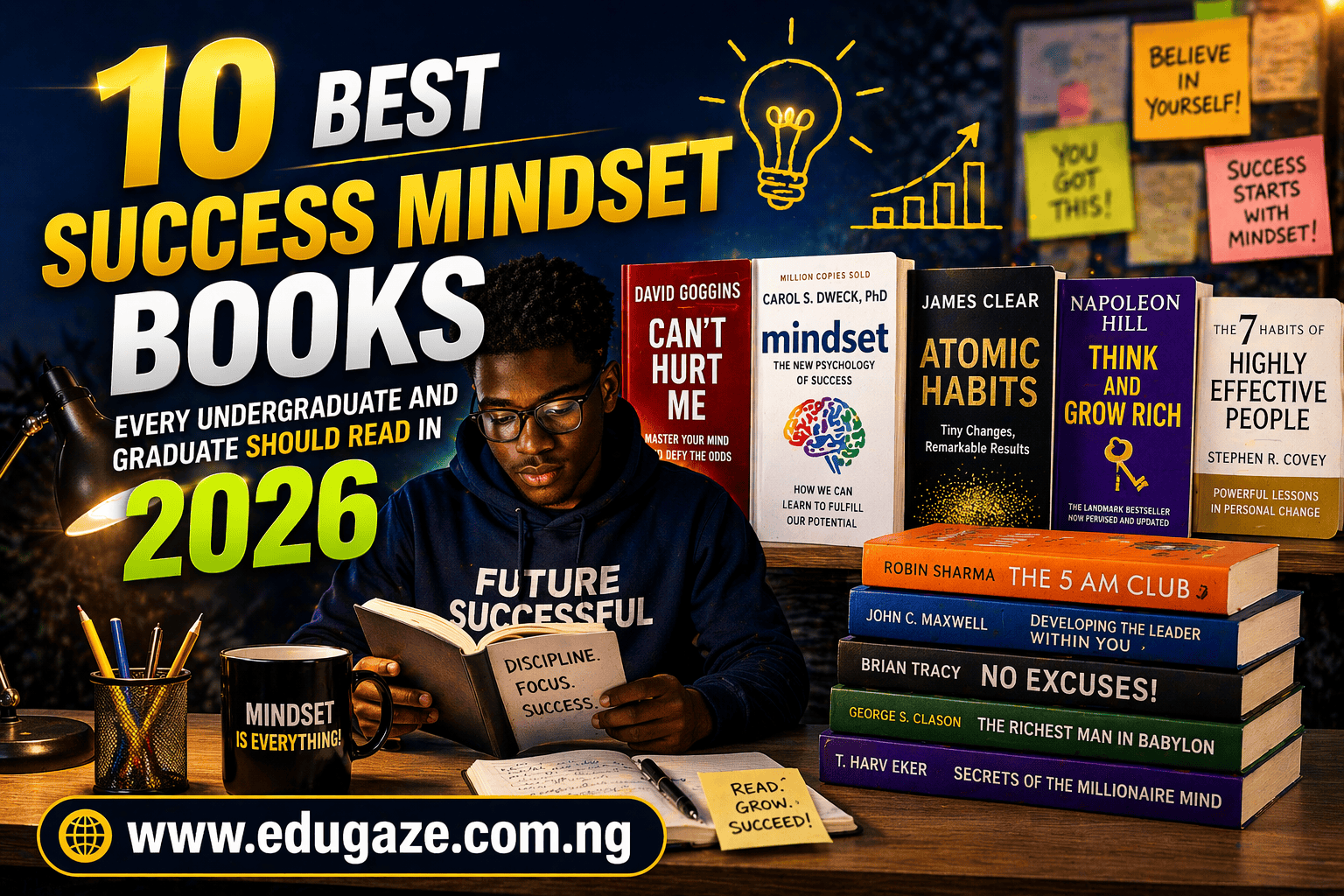
10 Best Success Mindset Books Every Undergraduate and Graduate Should Read in 2026
I will like to ask you this honest question — when was the last time you finished reading a book that actually changed the way you think?
Not a textbook. Not a handout. Not a PDF someone shared in a WhatsApp group at 11pm the night before an exam. I mean a real book — the kind that quietly shifts something inside your head and makes you see yourself and the world completely differently.
If you are struggling to remember, don’t worry. You are not alone. A lot of Nigerian undergraduates and graduates spend four, five, or even six years in school and come out having read everything the lecturer assigned — but nothing that actually prepared them for real life.
Here is the truth: the most successful people in the world are obsessive readers. Not because reading makes you look smart — but because the right books give you the mental frameworks, habits, and mindset shifts that most people never figure out on their own. And in a competitive world like the one we are living in right now in 2026, that difference in thinking can literally be the difference between struggling and thriving.
In this article, I am going to share the 10 best success mindset books every undergraduate and graduate should read in 2026. These are not just popular titles I picked off a bestseller list. These are books that have genuinely helped millions of people think better, act better, and build the kind of lives and careers they actually want.
Read this carefully from start to finish — and then go and get at least one of these books today.
Why Reading Mindset Books Actually Matters for Your Future
Before we get into the list, let me explain something that a lot of people misunderstand.
Mindset books are not motivational hype. The best ones are grounded in research, psychology, and real-world case studies. They teach you things like:
- How to build habits that stick without relying on motivation
- How to develop the kind of resilience that keeps you going when things get hard
- How to think more clearly and make better decisions under pressure
- How to manage your emotions so they work for you, not against you
- How to communicate, lead, and influence people effectively
Think of it this way:
- Your university degree is like the hardware of a computer — it gives you the raw processing power
- But mindset books are the software — they determine how well that hardware actually performs
You can have the best degree from the best university in Nigeria and still underperform in life if your thinking is working against you. That is why these books matter — and that is why the most successful graduates you know are usually also the ones who read the most.
Let’s get into the list.
1. Mindset: The New Psychology of Success — Carol S. Dweck
If there is one book on this list that I would make compulsory reading for every Nigerian undergraduate and graduate, it is this one.
Carol Dweck is a Stanford University psychologist who spent decades researching why some people succeed and others don’t — even when they have similar intelligence and opportunities. What she discovered is one of the most powerful ideas in modern psychology: the concept of the Fixed Mindset versus the Growth Mindset.
People with a fixed mindset believe that intelligence, talent, and ability are things you are either born with or you are not. They avoid challenges, give up easily, and treat failure as proof that they are not good enough.
People with a growth mindset believe that abilities can be developed through effort, learning, and persistence. They embrace challenges, learn from failure, and consistently improve over time.
The scary truth? Most of us — without realizing it — are operating with a fixed mindset in at least one area of our lives. And that mindset is quietly sabotaging our careers, our relationships, and our personal growth.
Why every undergraduate and graduate needs this book:
- It will completely change how you respond to failure, criticism, and setbacks
- It will help you understand why effort matters more than natural talent
- It will give you a framework for approaching challenges that most of your peers simply do not have
This is not just a self-help book. It is a science-backed blueprint for becoming the kind of person who keeps growing no matter what life throws at them.
2. Atomic Habits — James Clear
If Mindset by Carol Dweck changes how you think, then Atomic Habits by James Clear changes what you actually do every single day — and that combination is almost unstoppable.
James Clear spent years studying the science of habits and building systems for sustained improvement. His central argument is simple but profound: you do not rise to the level of your goals — you fall to the level of your systems.
Most people focus too much on goals and not enough on the habits and daily systems that make those goals inevitable. You want a first-class degree? A great job? A successful business? None of those things happen because you wanted them badly enough. They happen because of what you do consistently, day after day, even when you do not feel motivated.
Atomic Habits gives you a practical, research-backed framework for building good habits and breaking bad ones — using the concept of 1% improvements that compound over time into extraordinary results.
Why every undergraduate and graduate needs this book:
- It will teach you to build study habits, work habits, and personal discipline that stick
- It will help you understand why willpower alone never works — and what to use instead
- It is the most practically useful book on this entire list for daily life
This is the book that has probably changed more lives since 2018 than almost any other personal development book published in the last decade. If you only read one book on this list, make it this one.
3. Think and Grow Rich — Napoleon Hill
This is the grandfather of all success mindset books — and it has been continuously in print since 1937 for one reason: the principles inside it still work.
Napoleon Hill spent 20 years studying and interviewing over 500 of the most successful people in history — including Andrew Carnegie, Henry Ford, and Thomas Edison. His mission was to find the common thread that ran through all of their success stories.
What he found was not luck, connections, or inherited wealth. What he found was a specific mindset and philosophy of success that almost anyone can apply, regardless of their background or starting point.
The book covers powerful concepts like the power of definiteness of purpose, the mastermind principle, the importance of specialized knowledge, and the role of persistent action in achieving any goal.
Why every undergraduate and graduate needs this book:
- It will force you to define exactly what you want from life — most people never do this clearly
- It will teach you the mental habits that have driven financial and professional success for generations
- It is a reminder that success is not accidental — it follows a pattern that can be studied and repeated
Yes, some parts of the book feel dated — it was written in the 1930s, after all. But the core philosophy is as relevant in 2026 as it has ever been. Read it with an open mind and apply what resonates.
4. The 7 Habits of Highly Effective People — Stephen R. Covey
This is one of the best-selling non-fiction books of all time — and after reading it, you will immediately understand why.
Stephen Covey’s 7 Habits of Highly Effective People is not a motivational book. It is a deep, practical guide to personal and professional effectiveness built on timeless principles. The seven habits Covey outlines cover everything from personal responsibility and priority management to empathetic communication, teamwork, and continuous self-renewal.
The habits are organized around a simple but powerful idea: before you can be truly effective in your career and relationships, you have to first be effective in how you manage yourself.
The 7 Habits at a glance:
- Be Proactive — take responsibility for your life
- Begin with the End in Mind — know what you are working toward
- Put First Things First — prioritize what matters most
- Think Win-Win — seek mutual benefit in all relationships
- Seek First to Understand, Then to Be Understood — listen before speaking
- Synergize — value collaboration and teamwork
- Sharpen the Saw — continuously renew yourself physically, mentally, and spiritually
Why every undergraduate and graduate needs this book:
- It will give you a complete operating system for how to manage your time, your relationships, and your career
- It will make you significantly more effective in team environments, workplaces, and leadership roles
- It is one of the books most commonly recommended by CEOs, executives, and business leaders globally
If you are going into a professional career, building a business, or trying to lead people — this book is essential.
5. Grit: The Power of Passion and Perseverance — Angela Duckworth
Let me ask you something. Have you ever watched someone less talented than you achieve more than you? Have you ever started something with huge excitement only to quit when it got difficult?
If your answer is yes to either of those questions, Grit by Angela Duckworth was written for you.
Angela Duckworth is a psychologist and researcher who studied high achievers across diverse fields — military cadets, spelling bee champions, sales professionals, teachers, and students. Her research led her to one powerful conclusion: the single most reliable predictor of long-term success is not intelligence or talent — it is grit.
Grit is the combination of passion and perseverance. It is the ability to stay committed to your long-term goals even when progress is slow, obstacles are real, and motivation has completely disappeared.
Why every undergraduate and graduate needs this book:
- It will reframe how you think about failure and difficulty — not as signs to quit but as essential parts of the journey
- It will help you identify what you are truly passionate about and how to pursue it with persistence
- It is full of research-backed stories of people from ordinary backgrounds who achieved extraordinary things through sustained effort
In a generation that has grown up with instant results and fast gratification, this book is a powerful reminder that real success takes time — and that staying the course is a skill you can deliberately develop.
6. How to Win Friends and Influence People — Dale Carnegie
Here is something nobody tells undergraduates in Nigerian universities: your ability to get along with people, communicate persuasively, and make others feel valued is more important to your career success than almost any technical skill you will ever learn.
Dale Carnegie wrote How to Win Friends and Influence People in 1936, and it remains one of the most widely read and recommended books in the history of personal development — because the human principles it teaches are timeless.
The book teaches you how to genuinely connect with people, how to make a strong first impression, how to resolve disagreements without creating enemies, how to lead people without commanding them, and how to make people genuinely want to help you succeed.
Why every undergraduate and graduate needs this book:
- It will teach you the social and communication skills that determine career success more than your CGPA
- It will make you better at networking, job interviews, client relationships, and workplace politics
- It is the foundational book on emotional intelligence and human relations — skills every professional must have
Think of it this way:
- Technical skills will get you in the room
- People skills will determine how far you go once you’re inside
This book gives you the people skills that most graduates are never formally taught.
7. Deep Work: Rules for Focused Success in a Distracted World — Cal Newport
In a world of TikTok, Instagram, Twitter, WhatsApp notifications, and endless digital noise, the ability to focus deeply on difficult work for extended periods of time is becoming one of the rarest and most valuable skills in the world.
Cal Newport calls this skill Deep Work — and in this book, he makes a compelling case that the people who can do it consistently will dominate their fields in the coming years, while those who cannot will increasingly struggle to compete.
Newport defines deep work as professional activities performed in a state of distraction-free concentration that push your cognitive capabilities to their limit. In contrast, shallow work — emails, meetings, social media, administrative tasks — is what most people spend the majority of their working day doing.
The book is packed with practical strategies for building deep work habits, designing your environment to minimize distraction, and training your brain to focus deeply in an age that is deliberately engineered to pull your attention in a hundred directions.
Why every undergraduate and graduate needs this book:
- It will change how you study, work, and create — making you dramatically more productive in less time
- It will give you strategies to compete and stand out in a world where most people are shallow and distracted
- It is particularly relevant for anyone in knowledge work — writers, engineers, lawyers, marketers, programmers, researchers
If you are constantly struggling to concentrate, feeling overwhelmed by digital distraction, or wondering why you are always busy but rarely productive — this book has the answers.
8. Rich Dad Poor Dad — Robert T. Kiyosaki
Let’s talk about money — because no success mindset is complete without financial intelligence, and Rich Dad Poor Dad by Robert Kiyosaki is the book that has introduced more people to the basics of financial thinking than almost any other book in the last 30 years.
Kiyosaki tells the story of growing up with two father figures: his biological father — well-educated, hardworking, but perpetually financially struggling — and his best friend’s father — less formally educated, but financially brilliant and ultimately wealthy.
Through the contrast between these two men, Kiyosaki unpacks the core financial mindset differences between people who stay poor or middle-class their whole lives and those who build real wealth. He explains concepts like assets versus liabilities, the difference between working for money and making money work for you, financial literacy, and the importance of entrepreneurial thinking.
Why every undergraduate and graduate needs this book:
- It will fundamentally change how you think about employment, income, investing, and financial freedom
- It will challenge the conventional advice you have been given about getting a good job and saving money
- It is especially relevant for Nigerian graduates entering a tough economy where a salary alone is rarely enough
Important note: read this book for the mindset shift it provides, not as specific financial or investment advice. The core lesson — that financial education is something the school system almost never teaches you — is absolutely true and worth internalizing.
9. The Power of Now — Eckhart Tolle
This one is different from every other book on this list — and that is exactly why it belongs here.
The Power of Now by Eckhart Tolle is not about productivity, habits, or career success in the traditional sense. It is about something more foundational: learning to live and operate from a place of mental clarity and inner peace rather than constant anxiety, regret, and mental noise.
Tolle’s central message is that most human suffering — stress, anxiety, depression, overthinking — comes from spending too much mental energy in the past (regret, guilt) or the future (fear, worry), instead of being fully present in the moment that is actually happening right now.
For students and graduates dealing with the pressure of exams, job searches, comparison with peers, family expectations, and financial stress — this book is a lifeline.
Why every undergraduate and graduate needs this book:
- It will give you tools to manage stress, anxiety, and overthinking — problems that are epidemic among Nigerian graduates
- It will help you perform better under pressure by teaching you to focus on what you can control right now
- It will improve your mental health and emotional resilience in ways that no productivity book alone can
Think of it this way:
- All the good habits, hard work, and ambition in the world will not function well if your mind is constantly overwhelmed and distracted by worry
- This book is the foundation of mental clarity that everything else runs on
10. The Compound Effect — Darren Hardy
We close the list with a book that ties everything together — and delivers one of the most important lessons you will ever learn about how success actually works in the real world.
The Compound Effect by Darren Hardy is built around a single, deceptively simple idea: small, consistent actions taken over time produce extraordinary results. Not overnight. Not in one month. But over time — guaranteed.
Hardy uses powerful examples and research to show how tiny daily choices — the books you read, the food you eat, the people you spend time with, the way you spend your first 30 minutes each morning — compound over months and years into dramatically different life outcomes.
Two people with identical starting points can end up in completely different places five years from now not because of one big decision, but because of thousands of small daily choices that either moved them forward or held them back without them even noticing.
Why every undergraduate and graduate needs this book:
- It will help you understand why consistency matters more than intensity — and why small daily actions are more powerful than occasional bursts of motivation
- It will make you more intentional about your daily routines, habits, and the people you surround yourself with
- It is the perfect book to read alongside Atomic Habits — one explains the science, the other drives home the philosophy
If you want to understand why some graduates are thriving five years after school while others are still wondering what went wrong — this book has the answer.
Quick Summary: All 10 Books at a Glance
| # | Book Title | Author | Best For |
|---|---|---|---|
| 1 | Mindset: The New Psychology of Success | Carol S. Dweck | Developing a growth mindset |
| 2 | Atomic Habits | James Clear | Building daily success habits |
| 3 | Think and Grow Rich | Napoleon Hill | Goal-setting and success philosophy |
| 4 | The 7 Habits of Highly Effective People | Stephen R. Covey | Personal and professional effectiveness |
| 5 | Grit | Angela Duckworth | Building resilience and perseverance |
| 6 | How to Win Friends and Influence People | Dale Carnegie | Communication and people skills |
| 7 | Deep Work | Cal Newport | Focus, productivity, and distraction management |
| 8 | Rich Dad Poor Dad | Robert Kiyosaki | Financial mindset and intelligence |
| 9 | The Power of Now | Eckhart Tolle | Mental clarity and managing stress |
| 10 | The Compound Effect | Darren Hardy | The power of consistency over time |
Advantages of Reading These Books
Let me break down what you actually gain from committing to this reading list:
You will think differently from your peers
Most undergraduates and graduates are competing on the same credentials — same degree, same certificates, same experience. The ones who read consistently develop mental frameworks, communication skills, and emotional intelligence that give them a genuine edge in job interviews, business meetings, and professional relationships.
You will make better decisions faster
Every book on this list teaches you how to think more clearly — about your goals, your habits, your finances, your relationships, and your responses to challenges. Better thinking leads to better decisions. Better decisions lead to better outcomes. It is that simple.
You will handle failure better
Failure is not optional — it is guaranteed. Everyone who tries anything meaningful will fail multiple times. The difference is how you respond. Books like Grit, Mindset, and The Power of Now give you the mental tools to bounce back faster, learn from setbacks, and keep moving forward with clarity.
You will be more valuable to any employer or client
The habits, communication skills, focus strategies, and financial intelligence you gain from these books make you a more effective professional in any field. Employers can tell the difference between someone who just has a degree and someone who has invested in their personal development.
How to Get the Most Out of These Books
Reading a book once and moving on is not enough. Here is how to actually make these books work for you:
1. Read with a pen or highlighter
Mark passages that resonate with you. Underline insights that feel personally relevant. The act of highlighting forces you to engage actively with what you are reading rather than just scanning words.
2. Keep a reading journal
After each chapter or section, write down one or two things you learned and one specific action you can take based on what you just read. This bridges the gap between reading and actually changing.
3. Re-read the best ones
The most successful readers do not just read books once. They return to the most impactful ones every year. Books like Atomic Habits, The 7 Habits, and Mindset reveal new layers of insight every time you re-read them at a different stage of life.
4. Discuss with someone
Find a friend, classmate, or colleague who is also committed to self-development and discuss the books you are reading together. Teaching concepts to others is one of the most powerful ways to truly internalize them.
5. Apply before you finish
Do not wait until you finish the entire book to start applying what you have learned. Pick one idea from each chapter and implement it immediately. Immediate application is what separates readers who grow from those who just collect book titles.
My Personal Take
If I were an undergraduate or graduate in Nigeria in 2026 trying to set myself up for serious success, here is the order I would read these books:
- Start with Atomic Habits — because habits determine everything else
- Then read Mindset — because your beliefs about yourself determine how far your habits take you
- Then read Grit — because the journey will be harder than you expect and you need to be mentally prepared
- Then read The 7 Habits — to give yourself a complete framework for personal and professional effectiveness
- Then read Rich Dad Poor Dad — because financial intelligence is something school will never teach you
- Work through the rest over the following months — there is no rush; reading consistently beats reading in bursts
Think of it this way:
A university degree tells employers what subject you studied. But the books you read — and more importantly the thinking they shape — determine who you actually become. In 2026, the graduates who are winning are not just the ones with the best results. They are the ones who invested in their minds when everyone else was scrolling.
Conclusion: Which Book Should You Start With?
To put it plainly:
- Start with Atomic Habits if your biggest challenge is consistency and self-discipline
- Start with Mindset if fear of failure and self-doubt are holding you back
- Start with Grit if you tend to quit things when they get hard
- Start with How to Win Friends if you struggle with communication, networking, or relationships
- Start with Rich Dad Poor Dad if you are entering the workforce and want to think smarter about money from day one
- Start with Deep Work if distraction and lack of focus are your biggest problems right now
- Start with The Power of Now if anxiety, stress, and overthinking are affecting your performance and wellbeing
You do not have to read all ten books at once. Pick one that matches your most pressing challenge right now. Finish it. Apply what you learn. Then pick the next one.
That is the compound effect in action — and it is how the most successful graduates in Nigeria are quietly building their edge while everyone else waits for an opportunity to land in their lap.
My Final Advice
Here is what I would tell you if we were sitting across each other in a straightforward, no-nonsense mentoring conversation:
“Stop waiting until you graduate, until you get the job, until life settles down to start investing in your mind. The best time to read these books is right now — as a student, as a fresh graduate, as someone who is still figuring things out. Every insight you gain now becomes a foundation that compounds over the next five to ten years. The graduates who are ahead are not smarter than you — they just started reading earlier. Today is your earlier.”
Your degree opens doors. Your mindset determines what you do with them.
Did you find this article helpful? Share it with a student or graduate who needs to see this list. And if you have already read any of these books, drop your thoughts in the comments — I would love to know which one impacted you the most.
About the Author