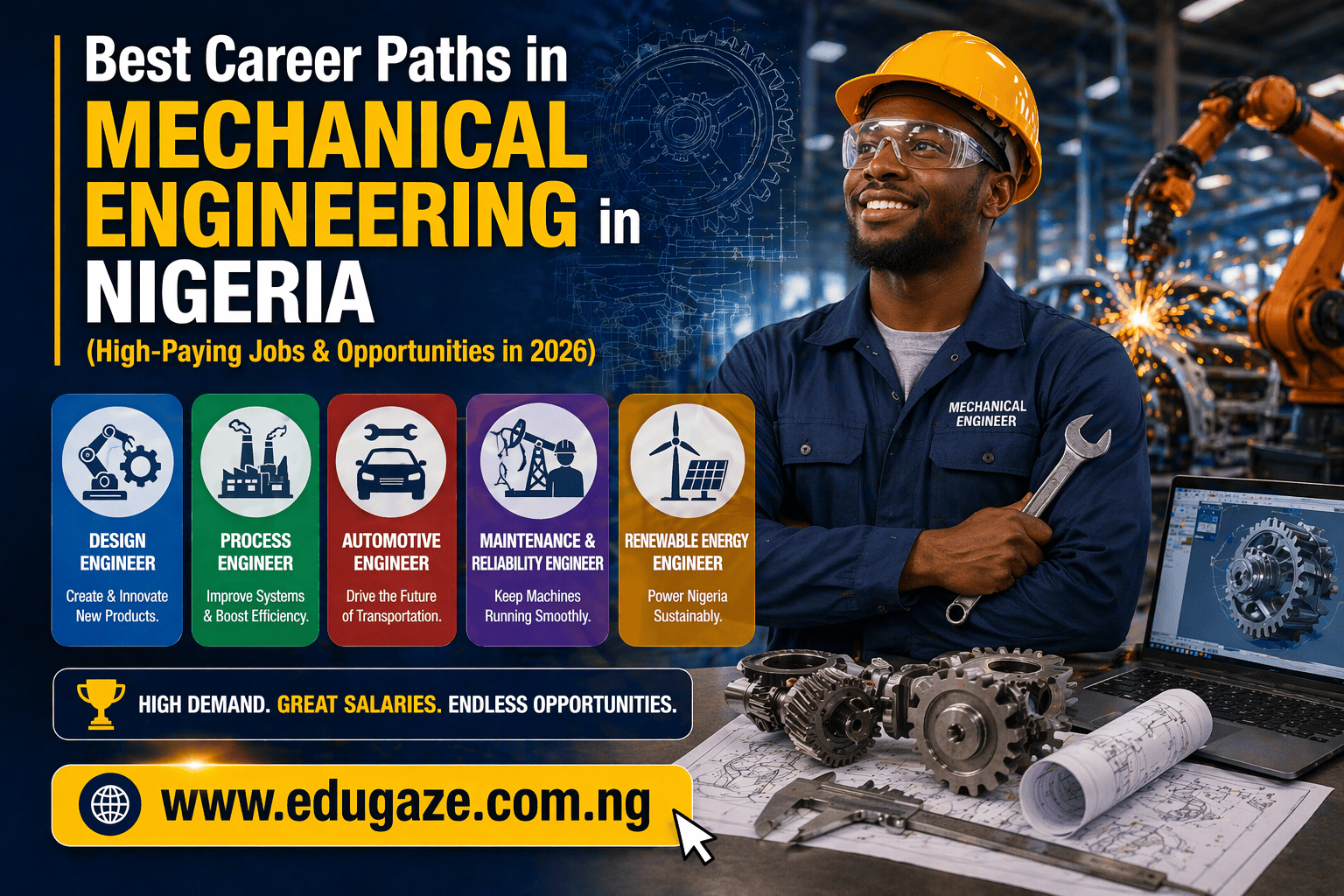
Best Career Paths in Mechanical Engineering in Nigeria (High-Paying Jobs & Opportunities in 2026)
Hey friend! If you studied Mechanical Engineering in Nigeria — or you are seriously considering it — I totally understand the confusion that follows the next question: “What am I supposed to do with this degree, and where is the real money?”
Trust me, I get it. Every year, thousands of Mechanical Engineering graduates pour out of Nigerian universities full of hope, and many of them end up settling for the first job that comes their way — not because they are not talented, but because nobody sat them down and explained which career paths actually pay well and which opportunities are growing right now.
Here is what I want you to know going into this article: Mechanical Engineering is one of the most versatile and well-paying engineering degrees you can have in Nigeria in 2026. The reason is simple — virtually every industry in this country needs mechanical engineers. From oil rigs in the Niger Delta to cement factories in Gboko, from FMCG plants in Lagos to power stations in Kano — mechanical engineers are everywhere.
But being everywhere does not automatically mean you are earning well. The difference between a mechanical engineer earning ₦120,000 per month and one earning ₦1,000,000+ is not just experience — it is also about which career path they chose and how well they positioned themselves.
In this guide, I am going to walk you through the best career paths in Mechanical Engineering in Nigeria, the specific jobs that pay the most, real salary figures for 2026, and exactly what you need to do to get there.
Grab something to drink — because this is the article you wish someone had shown you in your first year.
Why Mechanical Engineering Is One of the Best Degrees in Nigeria Right Now
Before we get into the career paths, let me give you the big picture of why this degree still holds enormous value in Nigeria today.
Mechanical Engineering covers everything that moves, rotates, generates heat, or requires physical force to operate. Think about it — turbines, engines, pumps, pipelines, compressors, vehicles, HVAC systems, manufacturing machines, and even medical devices all fall under the umbrella of mechanical engineering.
Now think about Nigeria:
- A country with massive oil and gas operations that depend on rotating equipment and pipelines
- A manufacturing sector that is slowly but consistently growing
- A construction industry that needs heavy equipment engineers
- An FMCG sector with some of the biggest food and beverage plants in West Africa
- A government infrastructure drive that is building roads, bridges, and power stations
Think of it this way:
- If Nigeria is a massive machine that is constantly trying to work and expand
- Then mechanical engineers are the people responsible for keeping all the moving parts running
That is why this degree opens doors across multiple industries — and why the salary potential is genuinely impressive when you choose the right path.
According to current 2026 data, mechanical engineers in Nigeria earn a median salary of around ₦352,500 per month, with top earners in industries like oil and gas and manufacturing pulling in ₦850,000 to over ₦1,100,000 per month. Entry level roles typically start between ₦80,000 and ₦200,000 per month, depending on the company and industry.
The gap between the bottom and the top is wide — which is exactly why this guide matters. Let’s get into it.
1. Oil & Gas Mechanical Engineering — The Highest Paying Career Path in Nigeria
Let me be completely honest with you from the start: if you want the highest salary as a mechanical engineer in Nigeria, the oil and gas sector is where you need to be.
This is not speculation. It is backed by job listings, salary surveys, and the experience of thousands of Nigerian engineers who have gone before you. Companies like Shell, TotalEnergies, Chevron, ExxonMobil, NNPC, and dozens of oilfield service companies like SLB (Schlumberger), Halliburton, Baker Hughes, and Oilserv Limited all depend heavily on mechanical engineers to keep their operations running.
In the oil and gas world, mechanical engineers are responsible for:
- Designing and maintaining pipelines and piping systems
- Managing rotating equipment like pumps, compressors, and turbines
- Overseeing FPSO (Floating Production Storage and Offloading) vessel systems
- Conducting integrity inspections and pressure vessel assessments
- Managing subsea mechanical systems and wellhead equipment
Common job titles you will see advertised:
- Piping and Pipeline Design Engineer
- Rotating Equipment Engineer
- Mechanical Integrity Engineer
- Process and Mechanical Design Coordinator
- Machine Shop Manager
What kind of salary should you expect?
- Entry Level (0–3 years): ₦200,000 – ₦400,000/month
- Mid Level (4–8 years): ₦500,000 – ₦800,000/month
- Senior Level (9+ years): ₦850,000 – ₦1,100,000+/month
A Machine Shop Manager role at a company like Hobark International in Port Harcourt currently advertises ₦850,000 – ₦1,100,000 monthly — and that is just what is publicly listed. Senior roles at multinationals often pay more when you factor in offshore allowances, hazard pay, and performance bonuses.
Think of it this way:
- Google AdSense is the gold standard for blog monetization — difficult to get into, strict with requirements, but absolutely the most rewarding once you are in
- Oil and gas is exactly the same for mechanical engineers — it takes more effort to break in, but once you are inside a major company, your earning potential is almost unmatched in Nigeria
How to break in:
Target graduate trainee programs. SLB, Halliburton, and Baker Hughes run structured programs specifically for fresh Nigerian engineering graduates. Also look out for openings at companies like Oilserv Limited, Saipem, and Technip Energies, which regularly hire mechanical engineers for project-based work in the Niger Delta.
2. Manufacturing & Production Engineering — Stable, Growing, and Widely Available
If oil and gas feels too competitive or too remote for your lifestyle, Manufacturing and Production Engineering is the next best thing — and honestly, for many engineers, it turns out to be the more practical and sustainable path.
Nigeria’s manufacturing sector is quietly but consistently expanding. Dangote Group, BUA Group, Nestle Nigeria, Unilever, Nigerian Breweries, Lafarge Africa, PZ Cussons, and dozens of other companies run large production facilities across the country that need mechanical engineers every single day.
As a manufacturing or production engineer, your job is to:
- Ensure production machines are running at peak efficiency
- Diagnose and fix mechanical faults before they shut down production lines
- Improve manufacturing processes to reduce waste and increase output
- Manage maintenance schedules and spare parts inventory
- Lead teams of technicians and artisans on the factory floor
Where can you work?
- FMCG companies (food, beverages, personal care products)
- Cement companies like Dangote Cement, BUA Cement, and Lafarge Africa
- Pharmaceutical manufacturing plants
- Textile and packaging companies
- Agro-processing and food production facilities
Salary range:
- Entry Level: ₦100,000 – ₦200,000/month
- Mid Level: ₦250,000 – ₦450,000/month
- Senior Level: ₦500,000 – ₦800,000/month
Here’s something really important about this path: manufacturing companies hire the most mechanical engineers in Nigeria by volume. This means more job openings, faster career progression if you are performing well, and opportunities to move between companies for salary increases. Many mechanical engineers use manufacturing as a launchpad before transitioning into more specialized or higher-paying sectors later in their careers.
3. HVAC Engineering — The Underrated High-Income Path Nobody Talks About
Okay friend, this one is going to surprise you — but hear me out.
HVAC stands for Heating, Ventilation, and Air Conditioning, and it is one of the most underrated and consistently profitable career paths for mechanical engineers in Nigeria.
Think about it. Every bank, hospital, hotel, shopping mall, data centre, office building, and manufacturing facility in Nigeria needs functional air conditioning and ventilation systems. As Nigeria’s urban development continues to grow — with more high-rise buildings, cold chain logistics facilities, and large commercial spaces being built every year — the demand for HVAC engineers is growing right alongside it.
HVAC engineers in Nigeria design, install, commission, and maintain climate control systems. They work on everything from simple split-unit installations in offices to complex central chiller plants in hospitals and data centres.
Why this path is especially attractive:
- Serious shortage of truly qualified HVAC engineers in Nigeria
- High demand from real estate, hospitality, healthcare, and banking sectors
- Many experienced HVAC engineers go on to run their own HVAC businesses, which can be extremely lucrative
Salary range:
- Entry Level: ₦80,000 – ₦180,000/month
- Mid Level: ₦250,000 – ₦500,000/month
- Senior Level: ₦600,000 – ₦900,000/month
And if you eventually set up your own HVAC installation and maintenance business with a few commercial clients, your monthly income can easily surpass what any salaried position would pay. Many private HVAC contractors in Lagos and Abuja are earning what most salaried engineers only dream about.
4. Maintenance Engineering — In Demand Everywhere, Every Single Day
Here is the truth about maintenance engineering: as long as machines exist, maintenance engineers will have jobs. It is one of the most universally in-demand roles for mechanical engineers across every industry in Nigeria.
Maintenance engineers are responsible for keeping industrial equipment, production machines, generators, pumps, and mechanical systems in working condition. They plan preventive maintenance schedules, respond to breakdowns, manage spare parts procurement, and ensure zero unplanned downtime in production environments.
Where are maintenance engineers hired?
Literally everywhere:
- Manufacturing and FMCG companies
- Hospitals and healthcare facilities
- Hotels and hospitality businesses
- Power plants and utility companies
- Bottling companies and breweries
- Cement plants and building materials companies
- Agro-industrial processing plants
Current job listings in Nigeria show maintenance roles paying between ₦160,000 and ₦300,000 per month at mid-level, with senior maintenance managers and leads earning ₦400,000 to ₦700,000+ in larger companies.
What makes a great maintenance engineer stand out:
- Knowledge of Predictive Maintenance (PdM) techniques
- Familiarity with Computerized Maintenance Management Systems (CMMS) like SAP PM, Maximo, or UpKeep
- Experience with reliability engineering and root cause analysis
- Strong leadership and team management skills
If you combine technical maintenance expertise with these modern tools and methodologies, your market value increases dramatically and quickly.
5. Piping & Structural Engineering — Design Work That Pays Very Well
If you are the kind of engineer who loves the design side of things — sitting with drawings, software, and specifications rather than being out on the factory floor — Piping and Structural Engineering is a highly rewarding career path that pays exceptionally well, especially in the oil and gas and construction industries.
Piping design engineers create the technical drawings and specifications for pipelines, piping systems, pressure vessels, and related structures. Structural engineers design the steel frameworks and load-bearing structures that support platforms, refineries, jetties, and industrial facilities.
Tools and software you need to master:
- AutoCAD and PDMS (Plant Design Management System) — the industry standards for piping design
- CAESAR II — for piping stress analysis
- STAAD.Pro or ETABS — for structural analysis
- Knowledge of international codes like ASME B31.3 and API standards for oil and gas piping
Where do piping and structural engineers work?
- EPC (Engineering, Procurement & Construction) firms
- Oil and gas companies and their contractors
- Construction and infrastructure companies
- Shipyards and offshore fabrication yards
- Government agencies overseeing large infrastructure projects
Salary range:
- Entry Level: ₦150,000 – ₦300,000/month
- Mid Level: ₦400,000 – ₦700,000/month
- Senior Level: ₦700,000 – ₦1,200,000/month
Piping Design Coordinators and Senior Structural Engineers at EPC firms and oil and gas contractors currently advertise roles that require 10+ years of experience with competitive senior pay packages. This is a career where patience and consistent skill-building pays off enormously.
6. Automotive & Fleet Engineering — Growing Fast in Nigeria’s Transport Sector
Nigeria has one of the largest vehicle fleets in Africa, and yet quality automotive and fleet engineering talent remains in very short supply. That gap is an opportunity for smart mechanical engineers who position themselves early.
Fleet engineers and automotive engineers in Nigeria manage the maintenance, performance, and reliability of vehicle fleets for companies in logistics, transportation, FMCG distribution, ride-hailing, and government agencies.
Companies like Max Drive, Kobo360, DHL Nigeria, Julius Berger, and various state and federal government agencies all maintain large vehicle fleets that require qualified engineers to keep them running efficiently.
What this career involves:
- Managing scheduled maintenance and repairs for commercial vehicles
- Monitoring fleet performance, fuel efficiency, and downtime metrics
- Sourcing and procuring spare parts and vehicle components
- Implementing safety and compliance standards across the fleet
- Overseeing a team of mechanics and automotive technicians
Salary range:
- Entry Level: ₦80,000 – ₦180,000/month
- Mid Level: ₦200,000 – ₦400,000/month
- Senior Level: ₦450,000 – ₦700,000/month
This path is growing fast in Nigeria as the logistics and e-commerce sectors continue to expand. If you develop expertise in electric vehicle (EV) technology — which is beginning to make its way into the Nigerian market — you will be ahead of most of your peers in the coming years.
7. Project Engineering & Management — The Highest Ceiling of All
Here is the advice I wish someone had given me earlier: the engineers who earn the most over the long run are not always the ones with the deepest technical skills. They are the ones who learn to manage people, budgets, timelines, and complex projects.
As a mechanical engineer with solid field experience and the right professional certifications, transitioning into Project Engineering and eventually Project Management can take your monthly income to a level that pure technical roles rarely reach.
Project engineers and managers in the engineering space are responsible for:
- Planning and scheduling engineering projects from start to finish
- Managing budgets, procurement, and subcontractors
- Coordinating between client, design team, and field execution team
- Ensuring projects are delivered on time and within budget
- Writing technical reports and presentations for clients and management
Certifications that will unlock this career:
- PMP (Project Management Professional) — the most widely recognized project management certification globally
- Prince2 Certification — popular with international firms operating in Nigeria
- COREN (Council for the Regulation of Engineering in Nigeria) — mandatory for professional engineering practice
Salary range:
- Entry Level (Project Engineer): ₦250,000 – ₦450,000/month
- Mid Level: ₦500,000 – ₦800,000/month
- Senior Level (Project Manager): ₦1,000,000 – ₦2,000,000+/month
Companies like Julius Berger Nigeria, Saipem, Oilserv, and large FMCG multinationals pay project managers at this level — especially those with oil and gas project experience. This is the career path where your mechanical engineering background becomes a launchpad to executive-level income.
Pros and Cons of Each Career Path
Let’s break it down like two friends being completely honest with each other.
Oil & Gas — Pros
- Highest salaries of any industry for mechanical engineers
- Excellent benefits: offshore allowances, hazard pay, health cover
- International project exposure and career growth
Oil & Gas — Cons
- Highly competitive at the entry level
- Field work often requires relocation to Port Harcourt or Delta State
- Can be a difficult sector to break into without internship experience or connections
Manufacturing / Production — Pros
- Most job openings in Nigeria by volume
- Stable employment with large reputable companies
- Clear career progression ladder
Manufacturing / Production — Cons
- Entry salaries can be modest
- Shift work is common in production environments
- Salary growth can be slower than oil and gas
HVAC Engineering — Pros
- Shortage of skilled engineers means you command better rates
- Excellent freelance and business startup potential
- Growing demand as Nigerian cities develop and expand
HVAC Engineering — Cons
- Less structured career progression in smaller firms
- Requires hands-on technical training beyond classroom knowledge
- Can be physically demanding during installation work
Project Management — Pros
- Highest earning ceiling in the long run
- Respected leadership role across all industries
- Transferable skills that work globally
Project Management — Cons
- Requires years of field experience before you can credibly transition
- PMP certification requires significant investment of time and money
- High responsibility and accountability can be stressful
Summary: All Career Paths and Salary Ranges in One Place
| Career Path | Best For | Entry Monthly Pay | Senior Monthly Pay |
|---|---|---|---|
| Oil & Gas Engineering | Engineers chasing the highest salary | ₦200k – ₦400k | ₦850k – ₦1.1M+ |
| Manufacturing & Production | Stable work with large FMCG firms | ₦100k – ₦200k | ₦500k – ₦800k |
| HVAC Engineering | Business-minded engineers and freelancers | ₦80k – ₦180k | ₦600k – ₦900k |
| Maintenance Engineering | Universally in demand across sectors | ₦100k – ₦200k | ₦400k – ₦700k |
| Piping & Structural Design | Design-focused engineers in oil & gas | ₦150k – ₦300k | ₦700k – ₦1.2M |
| Automotive & Fleet | Logistics and transport sector engineers | ₦80k – ₦180k | ₦450k – ₦700k |
| Project Engineering & Management | Engineers who want to lead and earn big | ₦250k – ₦450k | ₦1M – ₦2M+ |
What You Must Do Right Now to Earn Top Money as a Mechanical Engineer
I am not going to leave you with just information and no action plan. Here is exactly what you need to do to position yourself for the best salaries in Nigeria:
1. Register with COREN as Fast as Possible
The Council for the Regulation of Engineering in Nigeria (COREN) registration is not optional — it is the professional backbone of your engineering career. You need it to be taken seriously by top employers, especially multinationals and government agencies. Once you have your degree and one year of supervised experience, apply immediately. Do not procrastinate this.
2. Pick a Specialization Early
The biggest mistake Nigerian engineers make is staying too general for too long. Specialization is what separates average earners from high earners. Pick one or two of the career paths in this article that match your strengths and interests, and go deep. Read the right books, take relevant courses, and seek out companies in that specialization for your first or second job.
3. Learn the Right Software for Your Chosen Path
In 2026, employers expect mechanical engineers to come with relevant technical software skills. For manufacturing: SAP, AutoCAD. For piping design: PDMS, CAESAR II, ASME standards. For maintenance: CMMS platforms. For project management: Microsoft Project, Primavera P6. Whatever your path, make sure the software skills are there.
4. Build a Strong Network Through the Nigerian Society of Engineers (NSE)
Join the Nigerian Society of Engineers. Attend their annual conferences, state chapter events, and technical workshops. In Nigeria, who knows you is often just as important as what you know. Many high-paying mechanical engineering jobs — especially at the senior level — are filled through professional referrals and networks, not public job adverts.
5. Target Graduate Trainee Programs Aggressively
Companies like Dangote Group, Shell, Nestle Nigeria, Nigerian Breweries, and Julius Berger run structured graduate trainee programs specifically designed to bring young engineers in and develop them. These programs offer structured learning, mentorship, competitive starting salaries, and a fast track into professional engineering roles. Apply for all of them. Do not be picky at the start — your goal at the beginning is to get inside a good company and start building real experience.
My Personal Take
If I were a fresh Mechanical Engineering graduate in Nigeria in 2026, here is exactly what I would do:
- Get COREN registered as quickly as possible — this is your professional identity
- Target oil and gas companies or Dangote/BUA manufacturing plants for my first or second role — the exposure and training you get in these environments is unmatched
- Start learning piping design software like PDMS and CAESAR II on the side — these skills open doors in the highest-paying sector (oil and gas) and are in short supply in Nigeria
- Attend at least two NSE events per year — the connections you make at these events can change your career trajectory
- Pursue PMP certification within 5–7 years of starting work — because that is when the real money starts to come in
Think of it this way:
A Mechanical Engineering degree is like a newly launched blog — it has all the potential in the world. But the specialization, certifications, software skills, and professional network you build on top of it? Those are your SEO, your content strategy, and your monetization plan. Without them, the degree alone will only take you so far.
Conclusion: Which Career Path Should You Choose?
Let me wrap this up in the clearest terms possible:
- Choose Oil & Gas if you want the absolute highest salaries and are willing to put in the work to break into a competitive sector
- Choose Manufacturing & Production if you want immediate job availability, a stable career, and the chance to work for well-known Nigerian and multinational companies
- Choose HVAC Engineering if you are business-minded and eventually want to be your own boss
- Choose Maintenance Engineering if you want a skill that is in demand literally everywhere in Nigeria and across every industry
- Choose Piping & Structural Design if you are passionate about the design side of engineering and are willing to master specialized technical software
- Choose Automotive & Fleet Engineering if you are interested in vehicles and the growing logistics and transport sector
- Choose Project Management if your long-term goal is leadership, high income, and executive-level influence in any industry
And here is the best news: you do not have to stay on one path forever. Many of Nigeria’s highest-earning mechanical engineers started in manufacturing or maintenance, built their skills and experience, and then made the jump to oil and gas or project management — where the biggest money lives.
The path is there. The opportunities are real. Now it is your turn to go and take them.
My Honest Advice
Do not just graduate and go looking for any job. Be strategic. Know which industries pay the most, know which skills are in short supply, and position yourself where the demand is highest. Nigeria needs good mechanical engineers desperately — in oil and gas, in manufacturing, in construction, in energy. The opportunities are there and they are real. All you need is the right knowledge, the right certifications, and the discipline to keep building your skills year after year.
Your Mechanical Engineering degree is one of the best tools you could have in Nigeria in 2026. Now it is entirely up to you to decide what you build with it.
Do you Find this article useful? Please share it with a mechanical engineering student or graduate who needs to see this. And if you have questions about any of the career paths covered here, drop them in the comments section below — I read and reply to every single one.
About the Author