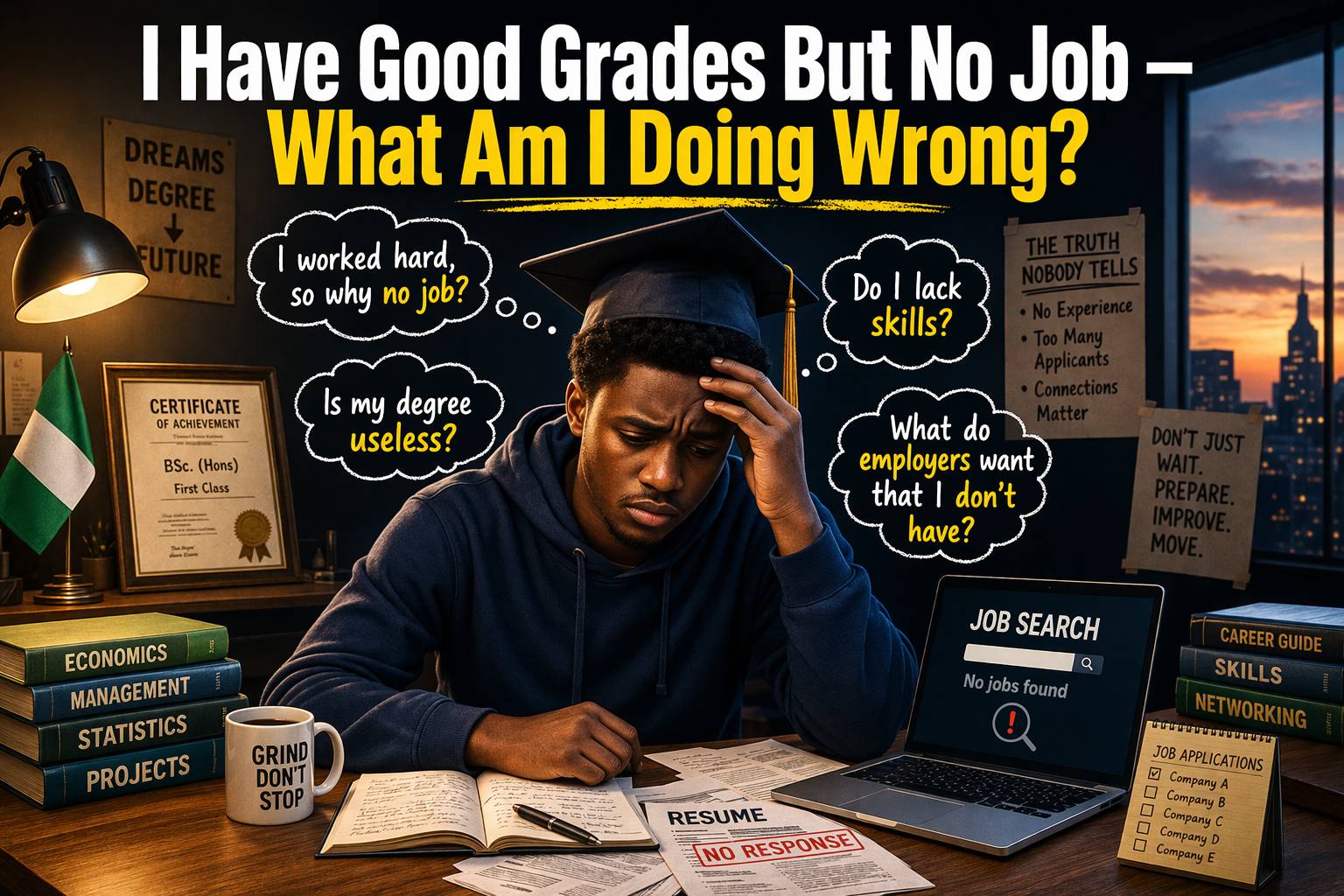
I Have Good Grades But No Job — What Am I Doing Wrong? (Complete Guide for Graduates)
You followed the path that was supposed to guarantee success.
You went to school.
You took your studies seriously.
You passed your exams with good grades.
You did what many people couldn’t do.
But now, instead of feeling ahead in life, you feel stuck.
No job.
No steady income.
No clear direction.
And the question keeps coming back:
“I have good grades but no job… what am I doing wrong?”
It’s frustrating, especially when you see others — sometimes even those who didn’t perform as well academically — getting opportunities and moving forward.
At some point, it starts to feel like something is missing.
And the truth is… something actually is.
The Reality Most Schools Don’t Prepare You For
While you were in school, success was simple.
Pass your exams = you’re doing well.
But outside school, the rules are different.
Employers are not just asking:
“What did you study?”
They are asking:
“What can you actually do?”
That’s where many graduates begin to struggle.
Because the system trained you to pass exams — not necessarily to solve real-world problems.
And that gap is what you’re experiencing right now.
Why You Have Good Grades But No Job
Let’s break it down clearly so you can understand what’s really happening.
1. Academic Excellence Without Practical Skills
Getting good grades shows that you are disciplined and intelligent.
But most companies are not hiring based on intelligence alone.
They want people who can:
-
Perform tasks
-
Solve problems
-
Use tools
-
Deliver results
For example, a graduate with a strong academic background in marketing may still struggle if they cannot run digital campaigns or analyze real data.
This is why someone with average grades but strong practical skills can sometimes get opportunities faster.
2. You Haven’t Built Real-World Experience Yet
Experience is one of the biggest factors employers look for.
Unfortunately, many graduates leave school without any real exposure to the working environment.
But here’s something important to understand:
Experience does not only come from paid jobs.
You can build experience through:
-
Internships
-
Volunteering
-
Freelance work
-
Personal projects
If you haven’t done any of these yet, it simply means you need to start now — not that you are incapable.
3. You’re Not Positioning Yourself Properly
You might be qualified, but if you don’t present yourself well, opportunities can pass you by.
Think about it this way:
Your CV and online presence are like your personal marketing tools.
If they are weak, employers may never see your true potential.
Common issues include:
-
Generic CVs
-
Lack of clear achievements
-
No focus on skills
-
Poor communication during interviews
Improving how you present yourself can make a big difference.
4. You’re Using an Outdated Job Search Approach
Sending out the same CV to multiple companies and hoping for a response is no longer effective.
The job market has changed.
Today, you need to:
-
Apply strategically
-
Customize your applications
-
Show how you fit the role
Blind applications rarely produce results.
5. You Don’t Have the Right Connections Yet
Many people underestimate how important relationships are in career growth.
A large number of opportunities come through:
-
Referrals
-
Recommendations
-
Professional networks
If you are not connected to people in your field, you may not even hear about certain opportunities.
6. You’re Depending Only on Your Degree
Your degree is valuable, but it is not enough on its own.
Think of it as a foundation — not the entire building.
To stand out, you need to add:
-
Skills
-
Experience
-
Practical knowledge
Without these, your degree may not translate into opportunities.
What You Can Start Doing Differently (My Honest Advice)
Now that you understand the problem, the next steps i will Advice you to take are :
Step 1: Learn a Skill That Has Market Value
If you want to increase your chances of getting a job or earning money, learning a practical skill is essential.
Focus on skills that are:
-
In demand
-
Practical
-
Applicable in real life
Some good options include:
-
Digital marketing
-
Data analysis
-
Web development
-
Graphic design
-
Copywriting
These skills can open doors beyond traditional employment.
Step 2: Start Building Experience Immediately
Instead of waiting for a company to hire you, start creating opportunities for yourself.
You can:
-
Work on personal projects
-
Offer your services for free initially
-
Help small businesses
-
Practice consistently
For example, if you learn graphic design, you can create designs for local businesses or online pages.
That becomes part of your experience.
Step 3: Improve Your CV and Online Presence
Your CV should clearly communicate your value.
Instead of listing only your education, include:
-
Skills
-
Projects
-
Achievements
-
Results
Also, build your presence online.
Platforms like LinkedIn can help you:
-
Connect with professionals
-
Showcase your work
-
Attract opportunities
Step 4: Apply for Jobs More Strategically
Rather than applying randomly, focus on:
-
Jobs that match your skills
-
Roles you are prepared for
-
Companies that align with your goals
Customize each application.
Show the employer that you understand their needs and can contribute.
Step 5: Build Relationships That Matter
Start connecting with people in your industry.
You can:
-
Follow professionals online
-
Engage with their content
-
Ask thoughtful questions
-
Learn from their experiences
Over time, these connections can lead to opportunities.
Step 6: Explore Alternative Income Paths
If traditional jobs are slow, consider other options.
You can:
-
Freelance
-
Work remotely
-
Offer services online
Many people are building income streams outside regular employment.
This can give you both experience and financial stability.
Step 7: Stay Consistent, Even When It Feels Slow
Progress may not be immediate.
There will be moments when it feels like nothing is working.
But consistency is what separates those who eventually succeed from those who give up.
Keep improving yourself daily.
Pro Advice
As you move forward, avoid these:
-
Waiting for the “perfect time”
-
Refusing to learn new things
-
Comparing yourself to others
-
Giving up too quickly
-
Ignoring opportunities to grow
Note:
Having good grades is not a disadvantage.
In fact, it shows that you have:
-
Discipline
-
Focus
-
Ability to learn
What you need now is to combine those qualities with practical action.
Once you do that, your results will begin to change.
Final Thoughts
If you have good grades but no job, it does not mean you are doing everything wrong.
It simply means your strategy needs adjustment.
Success today is not based on one factor alone.
It is a combination of:
-
Knowledge
-
Skills
-
Experience
-
Action
What You Should Do From Here
Start small, but start immediately.
Choose one skill.
Begin learning.
Practice consistently.
Improve your presentation.
Connect with people.
Over time, these steps will create opportunities for you.
Closing Thought
Your grades got you this far.
What takes you further is what you choose to do next.
About the Author





Hi, this is a comment.
To get started with moderating, editing, and deleting comments, please visit the Comments screen in the dashboard.
Commenter avatars come from Gravatar.