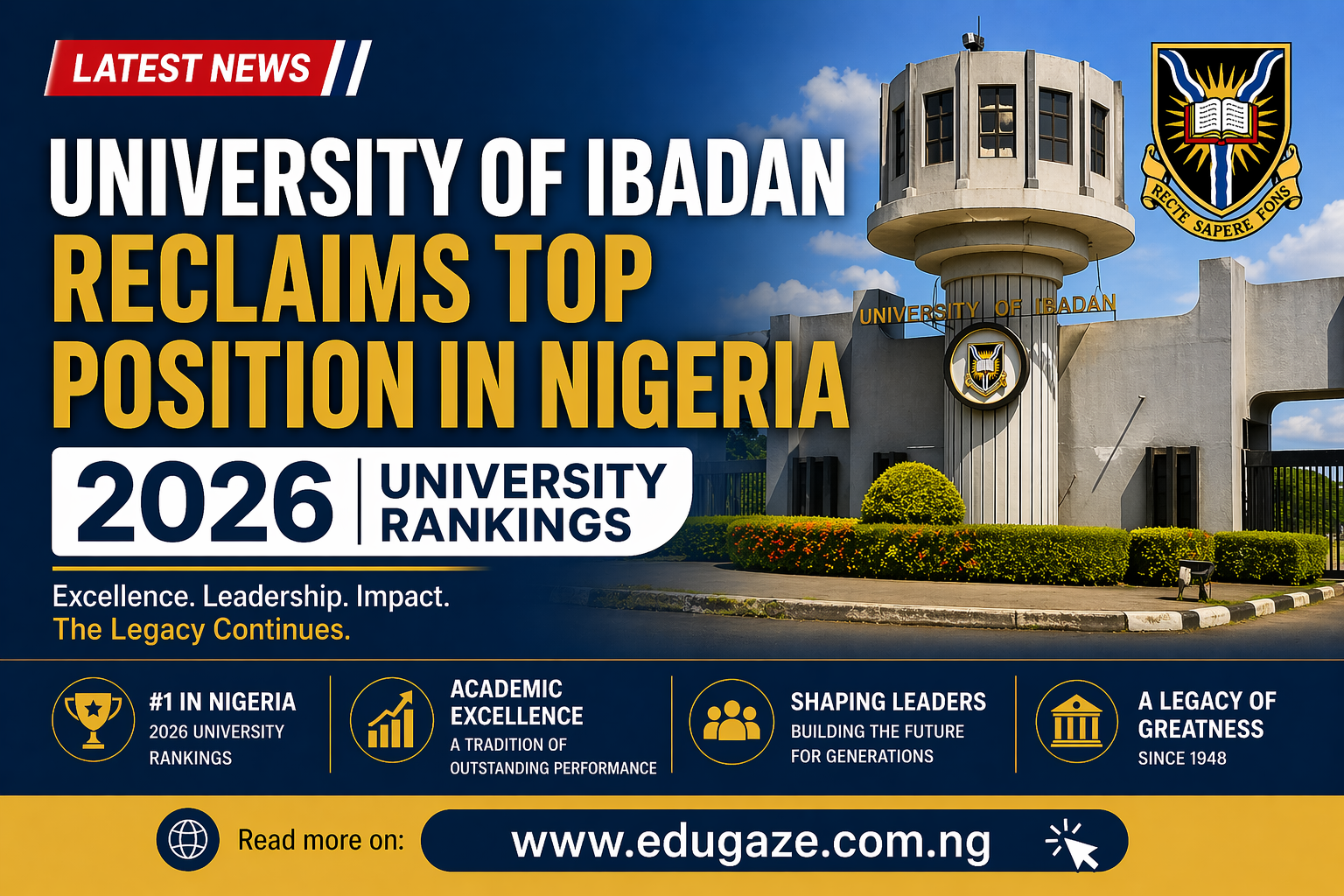
University of Ibadan Reclaims Top Position in Nigeria 2026 University Rankings | Latest Higher Institution News in Nigeria
The Nigerian higher education sector has entered another competitive phase in 2026, with renewed attention on university performance, global ranking outcomes, and institutional development.
At EduGaze, our editorial team has reviewed recent ranking publications, institutional performance indicators, and academic discussions across multiple education platforms. From this review, one development stands out clearly: the University of Ibadan has re-emerged as the highest-ranked university in Nigeria in the latest 2026 global ranking cycle.
This development has generated widespread discussion among students, academic staff, policymakers, and education observers across the country. It is not just a ranking update—it reflects ongoing changes in research output, academic competitiveness, and institutional performance across Nigerian universities.
University of Ibadan Returns as Nigeria’s Number One University
The institution at the center of this development is:
University of Ibadan
According to multiple ranking indicators widely referenced in 2026 higher education updates, the University of Ibadan has regained its position as Nigeria’s top university, outperforming several federal and private institutions in key academic performance categories.
The ranking assessment typically evaluates universities based on:
- Research quality and output
- Academic reputation
- Teaching environment
- Citation impact
- Industry and international collaboration
- Institutional visibility
From available performance summaries, UI maintained a strong position particularly in research output and academic influence, which remain critical indicators in global university evaluations.
Why This Ranking Update Is Trending in Nigeria
This development is trending across Nigerian education communities for several important reasons.
1. Increased Competition Among Nigerian Universities
In recent years, Nigerian universities have become more competitive, especially among top-tier institutions such as:
University of Lagos
Covenant University
Ahmadu Bello University
University of Nigeria Nsukka
Each of these institutions has made significant investments in academic programs, infrastructure, and research development. As a result, ranking movements are now closely monitored by students and stakeholders.
2. Students Are More Ranking-Aware Than Before
One key shift observed by education analysts is that students are no longer choosing universities based only on admission availability or location.
Today, students consider:
- National and global ranking position
- Employability of graduates
- Research exposure opportunities
- Academic reputation
- Industry partnerships
Because of this, ranking updates like this one quickly become viral across campuses and social media platforms.
3. Focus on Research and Academic Productivity
Another key factor driving UI’s position is its strong research culture. The institution continues to prioritize:
- Postgraduate research development
- Academic journal publications
- Faculty research output
- International academic collaboration
These factors significantly influence global ranking systems, especially those focused on research impact and citation strength.
Key Factors Behind University of Ibadan’s Performance
Based on institutional performance patterns and education analysis, several factors contributed to UI’s leading position in Nigeria.
Strong Academic Reputation
UI remains one of Nigeria’s oldest and most respected universities. Its historical foundation continues to support its academic reputation locally and internationally.
Improved Research Output
Research remains one of the strongest performance indicators in global rankings. UI has consistently improved in:
- Peer-reviewed publications
- Citation impact
- Research funding utilization
- Postgraduate academic output
International Collaboration
The university has expanded partnerships with foreign institutions in areas such as:
- Medicine and public health
- Environmental science
- Engineering research
- Social sciences and policy studies
These collaborations improve visibility and global academic influence.
Digital Learning Expansion
Like many modern institutions, UI has increased its investment in:
- Online learning platforms
- Hybrid lecture systems
- Digital academic resources
- Virtual research collaboration tools
This transition has strengthened its adaptability in modern education systems.
Performance Overview of Other Leading Nigerian Universities
While UI currently leads, other institutions also remain highly competitive in the 2026 academic landscape.
University of Lagos (UNILAG)
University of Lagos continues to maintain strong academic influence, particularly in:
- Law
- Business studies
- Engineering
- Social sciences
- Industry-linked programs
Its location in Nigeria’s commercial capital also contributes to strong industry partnerships and student opportunities.
Covenant University
Covenant University remains one of the strongest private universities in Nigeria. It is widely recognized for:
- Academic discipline structure
- ICT-driven learning environment
- High graduation performance rates
- Strong institutional governance
The institution continues to compete closely with federal universities in academic rankings.
Other Key Institutions
Other universities that consistently appear in top Nigerian rankings include:
- Ahmadu Bello University (ABU)
- University of Nigeria Nsukka (UNN)
- Bayero University Kano (BUK)
- Obafemi Awolowo University (OAU)
These institutions continue to contribute significantly to Nigeria’s academic development and research output.
What This Means for Nigerian Students
This ranking update has several direct implications for students across Nigeria.
1. Increased Admission Competition
As top universities maintain or improve their rankings, admission into competitive courses is expected to become more intense.
Courses likely to see increased competition include:
- Medicine and Surgery
- Law
- Engineering
- Computer Science
- Pharmacy
2. Greater Focus on Institutional Quality
Students are now more likely to prioritize:
- Teaching quality
- Research exposure
- Graduate employability
- International recognition
This shift is changing how students select universities in Nigeria.
3. Degree Value Perception
Graduating from a higher-ranked institution may improve:
- Employment opportunities
- Postgraduate admission chances
- International scholarship eligibility
- Professional credibility
Challenges Still Affecting Nigerian Universities
Despite improvements, several challenges continue to affect the higher education system.
Funding Limitations
Many public universities still struggle with:
- Insufficient research funding
- Infrastructure gaps
- Laboratory and facility limitations
Academic Staff Migration
Brain drain remains a significant issue, as many lecturers seek better opportunities abroad.
Academic Calendar Disruptions
Frequent disruptions caused by industrial actions still affect academic consistency in some institutions.
Expert Analysis: What Needs to Improve
From an education development perspective, several areas require attention to improve Nigeria’s global competitiveness:
- Increased investment in research infrastructure
- Better staff welfare and retention policies
- Stronger industry-academic partnerships
- Stable academic calendars
- Expanded digital learning systems
Without sustained improvements in these areas, Nigerian universities may continue to perform better locally than globally.
Editorial Insight: Where Nigerian Higher Education Is Headed
At EduGaze, our analysis suggests that Nigerian higher education is gradually evolving into a more competitive and performance-driven system.
The 2026 ranking update highlights three major realities:
- Nigerian universities are improving in academic output
- Competition among institutions is becoming stronger
- Students are becoming more informed and selective
However, global competitiveness still requires long-term structural investment and policy consistency.
Conclusion: A Positive Step, But More Work Ahead
The return of the University of Ibadan as Nigeria’s top university in 2026 is a positive development for the country’s education sector. It reflects progress in research, academic quality, and institutional performance.
However, it also highlights the gap between Nigerian universities and top global institutions. While progress is being made, sustained investment and policy support are necessary to maintain and improve these gains.
For students, this development reinforces an important message: university choice in Nigeria is no longer just about admission—it is about long-term academic and career positioning.
About the Author